
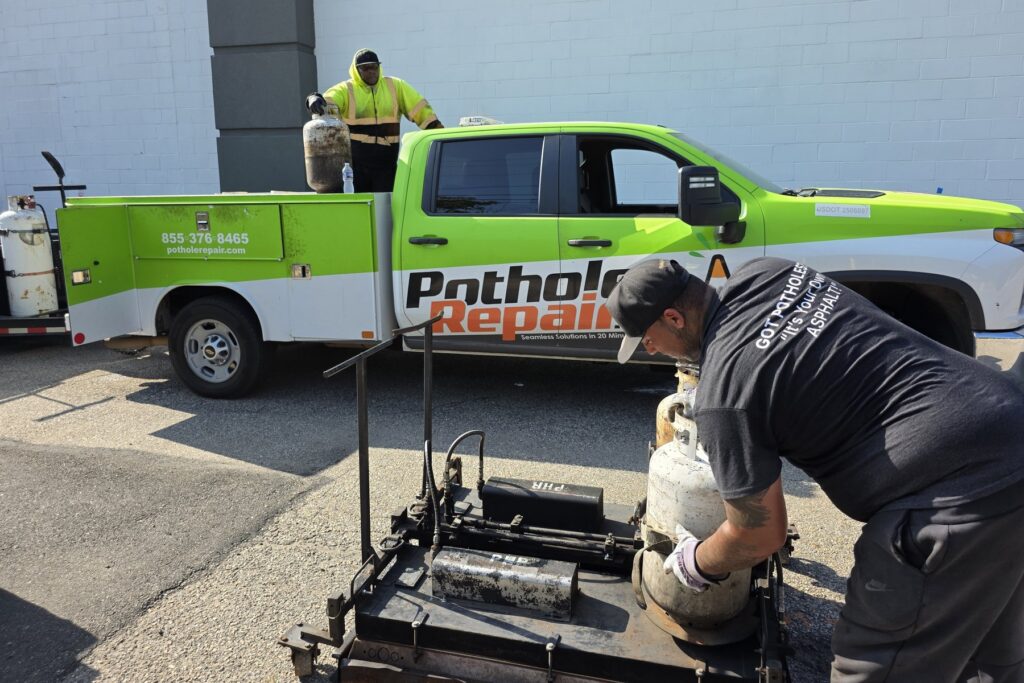
Church parking lot repair has a scheduling problem that a retail lot never has. The lot sits nearly empty from Monday to Saturday, then fills to the last space for two hours on the weekend, with the oldest members, the youngest children and the slowest walkers all crossing the same asphalt at once. A pothole that would be noticed by Tuesday on a grocery store lot can sit unseen on a church lot for a month, because nobody walks the far rows midweek.
That pattern shapes everything about how a congregation should handle its pavement: where the damage forms, who finds it, how a volunteer facilities committee approves the work, and when a crew can be on site without a service, a funeral or a school drop-off in the way. This guide covers all of it for the people who actually carry the lot, usually a trustee, a property committee chair or a business administrator, across the Mid-Atlantic and Florida.
Key takeaways
- Church lots fail at the entrance apron, the drop-off loop, the accessible stalls nearest the door and the dumpster pad, because those spots take every turning wheel the lot sees in a two hour window.
- The accessible route from the marked stalls to the entrance is the first place to check. The 2010 ADA Standards allow a vertical change of only a quarter inch on an accessible route; anything over half an inch has to be ramped.
- A congregation does not need a paving project to fix a handful of potholes. Each failure point can be repaired on its own, in about 20 minutes, with the repair tier chosen per location.
- Midweek mornings are the natural repair window. The lot stays open while the crew works a few spaces at a time, so an office, a food pantry or a weekday school keeps running.
- A dated inspection report with photos is the document a board, an insurer or an attorney asks for first. Scheduled inspections three times a year keep that record current without adding work for volunteers.
Why Do Church Parking Lots Fail Differently From Retail Lots?
Direct answer: Traffic on a church lot arrives in a surge rather than a steady flow. Water sits in the empty lot all week, the surge of turning vehicles works the weak spots on the weekend, and nobody is watching the pavement in between. Damage grows unobserved until a member reports it, usually on the busiest Sunday of the season.
A retail center has staff walking the lot every day and a manager whose job includes the pavement. A congregation has a volunteer who looks at the lot on the way in and a budget that was set at an annual meeting. The asphalt does not know the difference, but the maintenance pattern does. Small cracks that would be flagged in a week on a managed property get a full season of rain, snow or afternoon storms on a church lot before anyone writes them down.
The surge matters more than the volume. A Sunday morning puts several hundred vehicles through one or two entrances, all braking and turning in the same lanes within minutes of each other, then puts them all back out again. Turning and braking wheels load the pavement far harder than straight travel does, and they do it where the lot is already weakest: the apron at the road, the loop in front of the entrance, and the rows nearest the building where the asphalt was laid first and patched most. A faith-based school adds a weekday version of the same thing, with a drop-off line that stops and starts in the same ten feet of pavement twice a day.
Climate finishes the job. In Baltimore, Philadelphia and Northern New Jersey, water that entered the base in November freezes and thaws through March, and the first open potholes show up right before Easter, the busiest weekend on most church calendars. In Orlando and Jacksonville there is no freeze, but a summer of daily afternoon storms soaks the base of a cracked lot for five months while attendance is lowest and the lot is emptiest. Either way, the damage is done during the quiet season and discovered during the busy one.
Where Do Potholes Show Up First on a Church Lot?
Direct answer: At the entrance apron, in the drop-off loop, along the accessible stalls closest to the door, around the dumpster pad and at any unpaved edge where the lot meets grass or gravel. Those are the places where water collects and wheels turn, which is the combination that opens asphalt. Walk them first, before the rest of the lot.
Our inspectors see the same handful of locations fail on worship properties across every metro we serve. The table below is the order we walk a church lot in, and the order a facilities committee should walk it in too.
| Location | Why it fails | Priority |
|---|---|---|
| Entrance apron off the road | Every vehicle turns in and out over the same strip; road runoff crosses it after each storm. | High. Vehicle damage claims start here. |
| Drop-off loop and entrance curb line | Stop-and-go turning in a tight radius, plus the heaviest foot traffic on the property. | High. Trip-and-fall exposure for members being dropped off. |
| Accessible stalls and the route to the door | Usually the oldest asphalt on the lot, closest to the building, and the route walked by the members least able to step around a hole. | Highest. Accessibility and liability at once. |
| Dumpster pad and service entrance | The only heavy truck on the property stops and lifts in the same spot every week. | Medium. Out of sight but it spreads toward the drive aisle. |
| Unpaved edges and overflow boundaries | No curb to hold the edge, so overflow parking on holidays breaks it off a few inches at a time. | Medium. Ravels inward toward marked stalls. |
| Downspout discharge points and low corners | Roof water from a large sanctuary roof lands on the same square yard of asphalt in every storm. | Watch. Standing water here predicts the next pothole. |
One habit worth adopting: walk the lot the morning after a hard rain, not on a dry Sunday. Water still standing an hour after the storm ends is sitting on cracks and soaking the base underneath. Those puddles map next spring’s potholes with surprising accuracy, and they are invisible once the lot dries. The reason earlier patches fail at the seam is the same water working the same spots.
What Should a Facilities Committee Check Before the Weekend?
Direct answer: Four things: any open hole in a drive lane or stall, any raised or sunken edge on the accessible route from the marked stalls to the entrance, standing water in a walking path, and loose asphalt at the entrance apron. Photograph each one with the date. That list is the whole pre-weekend check and it takes fifteen minutes.
The accessible route deserves its own paragraph, because it is where a congregation’s good intentions and its pavement most often disagree. The 2010 ADA Standards for Accessible Design allow a vertical change in level on an accessible route of no more than a quarter inch. Between a quarter inch and a half inch the edge has to be beveled, and anything greater than half an inch has to be ramped. A settled patch, a heaved seam at a utility cut or a raveled edge where the stall meets the access aisle can exceed that in one winter. A church that painted new accessible stalls three years ago may have a route today that a walker or a wheelchair cannot cross cleanly. This is a design standard, not legal advice, and it is useful precisely because it is specific.
Everything on the list gets a dated photo, even a phone snapshot, because liability on a parking lot follows the record of what was known and when. A folder of dated photos and a repair order is a stronger position than a memory that the lot looked fine.
Which Repair Method Fits a Congregation Budget?
Direct answer: The one chosen per location, not per lot. A permanent thermal repair belongs on the entrance, the drop-off loop and the accessible route, where a reopened hole costs the most. A semi-permanent hot patch suits a mid-lot stall. A temporary cold fill makes a hazard safe this week on a spot already planned for a later project.
Congregations tend to assume the choice is between doing nothing and funding a repaving project at a congregational meeting. It is not. Most asphalt paving companies are set up for large jobs and lose money on a handful of small repairs, which is why a church with six potholes struggles to get a crew to show up at all. Our business was built in 2010 around exactly that gap: commercial parking lot pothole repair done one failure point at a time, with one truck and a small crew, so a single pothole is as workable as a schedule of thirty.
Three repair tiers cover nearly every situation a facilities committee faces. The infrared asphalt repair we call Permanent Thermal Repair heats the existing asphalt in place and reworks it with the new material so the repair fuses with the pavement around it. There is no seam for water to enter, which is the mechanism that makes most patches fail, so it is the right tier where the lot earns its liability: the apron, the loop, the accessible route. Semi-Permanent Hot Patch is a conventional hot mix repair that holds well in lower traffic rows. Temporary Cold Fill is the honest stopgap: it makes an open hole safe immediately, it is expected to be replaced, and it is the right call for a spot that will be inside a larger project next year.
| Church lot situation | Fitting tier | Why |
|---|---|---|
| Pothole on the accessible route or at the entrance | Permanent Thermal Repair | Seamless bond, longest service life, highest exposure if it reopens. |
| Failed old patch in the drop-off loop | Permanent Thermal Repair | The old patch failed at its seam; a second seam would fail the same way. |
| Mid-lot stall used on holidays only | Semi-Permanent Hot Patch | Low turning load, fits a tight budget. |
| Hole in an area slated for a future capital project | Temporary Cold Fill | Removes the hazard now without spending on pavement that will be replaced. |
| Hole found Friday before a holiday weekend | Permanent Thermal Repair if the schedule allows; Cold Fill plus a cone if not | Safety first, then the lasting repair on the next open weekday. |
The mechanism that makes this work for a volunteer board is the inspection report. After a free inspection, the committee receives an interactive report that shows the lot from above, with each failure point marked, time-stamped photos and the repair options for that spot. The chair can choose a tier for each location and approve the work with a click, between meetings, instead of waiting for the next quarterly session. When the work is done, the after photos attach to the same record. For a committee that meets monthly and turns over every few years, having the whole history in one place matters more than any single repair. The HOA board approach to pothole repair budgeting works the same way, for the same reasons.
How Do You Schedule Repairs Around Services, Schools and Funerals?
Direct answer: Book a midweek morning, give the crew the week’s calendar from the church office, and keep the lot open. Each repair takes about 20 minutes and the crew works a few spaces at a time, so a weekday school, an office or a food pantry runs as usual. Call about funerals and weddings; they are never on the annual calendar.
Worship properties are the easiest lots on our schedule and the hardest to schedule, at the same time. Easy, because the lot is empty on a Tuesday morning and there is room to stage the truck without displacing anyone. Hard, because the calendar is not the Sunday schedule. A church office knows about a Thursday funeral, a Saturday wedding, a Wednesday evening class, a food pantry distribution on the second Tuesday and a preschool pickup line at 11:30. The crew needs that list once, at booking, and then works around it.
The reason this is possible is that the repair itself is quick and quiet. There is no excavation, no dump truck, no lane closure. A Permanent Thermal Repair heats and reworks the existing asphalt in place, and most are finished in about 20 minutes. The crew cones off the few spaces it is working in and moves on. Many facilities managers tell us the holes were simply gone before anyone noticed a crew on site, which is the same approach we use for a hotel lot that never closes or a school with a drop-off line.
Two scheduling points catch congregations by surprise. First, holiday weeks are the wrong time to be waiting on a repair; the entrance and the accessible route should be inspected and repaired well before Easter, Christmas, Ramadan or the High Holy Days, not the week of. Second, winter does not close the window in the Mid-Atlantic. Asphalt plants shut down for the season and conventional repair stops with them, but the thermal method brings its own heat, so a pothole that opens in a February freeze can be repaired permanently in February rather than cold-filled until April. Our note on infrared asphalt repair in winter covers what still limits any winter repair.
Does a Church Need a Maintenance Plan for One Parking Lot?
Direct answer: Yes, and a single lot is the case where a plan helps most, because the volunteers who watch it change. Scheduled inspections three times a year, each with a written report, replace the memory of whoever happens to chair the committee. The report also identifies damage outside our scope, such as drainage, so the board hears about it early.
The weakness of a volunteer facilities committee is not effort. It is continuity. The trustee who knew the lot’s history rotates off, the next one inherits a budget line and no record, and the lot goes two years between anyone looking closely at it. A plan fixes that by making the inspection the constant. Under the PARC Plan, our specialists inspect the property three times a year, timed to the seasons that break pavement in that region: after the freeze and thaw in the Mid-Atlantic, after the wet season in Florida. Each visit produces the same interactive report, so the board always holds a current, dated record of the lot’s condition, with photos, whether or not it orders any work that quarter.
Two parts of the plan matter more to a congregation than to a retail operator. The report identifies out-of-scope damage, so a drainage problem or a section of base failure gets documented even though it is not something we repair, and the board learns in time to plan a campaign rather than react to a collapse. And the written record is what an insurer, an attorney or the diocese asks for when a member reports a fall. PARC members also receive priority scheduling and an extended warranty on repairs.
When Is Pothole Repair the Wrong Call for a Church Lot?
Direct answer: When the whole surface has failed rather than spots on it. Interconnected cracking across a drive aisle, a lot that ponds over a wide area, or a base that moves under a wheel are reconstruction or drainage problems. We repair and save existing asphalt; we do not repave, and we will say so in the inspection report.
Honesty about scope saves a congregation money twice. Spot repair is the right tool when the lot is fundamentally sound and has failed at the usual points. It is the wrong tool when the pavement has reached the end of its life across a large area, and a crew that repairs forty holes on a lot that needs rebuilding has spent the church’s money on pavement that will keep failing between the repairs. Our inspection report separates the two: it marks the repairs that are in scope, documents the sections that are not, and gives the board a clear picture to take to a paving contractor for that part of the work. It is the same question an emergency repair triage asks: which failures need a crew this week, and which belong in a capital plan.
Gravel overflow lots and unpaved field parking are outside our work entirely. What is inside it is most of what a church actually has: a sound lot with potholes at the entrance, the loop, the accessible stalls and the dumpster pad, and a committee that would rather fix those this month than fund a full project this decade. Our pothole repair for religious institutions page covers houses of worship, faith-based schools and community centers, and the commercial asphalt repair options are the same ones every property type in Washington, DC, Richmond and Fairfax chooses from.
Frequently Asked Questions
Who is responsible for maintaining a church parking lot?
The property owner, which for most congregations means the church itself, acting through its trustees, vestry, board or a diocesan property office, depending on how the congregation is organized. If the lot is leased or shared with a school or another organization, the agreement usually says who maintains it. The practical answer is whoever holds the maintenance budget and the inspection record. This is general guidance, not legal advice.
Is a church parking lot private property, and does that change who is liable for potholes?
A church lot is private property that the public is invited onto, which is the same position as a store or an office park. The owner is expected to keep it reasonably safe for the people it invites in. Being a nonprofit or a house of worship does not remove that duty. A dated inspection and a prompt repair record are the documents that show the duty was taken seriously. Ask the congregation’s attorney or insurer about the specifics.
How long does a church parking lot repair take?
Most individual repairs are completed in about 20 minutes. A typical church lot with a handful of potholes at the entrance, the drop-off loop and the accessible stalls is usually done in a single midweek morning, and the lot stays open the whole time because the crew works a few spaces at a time.
Can repairs be done during the week without closing the lot or disturbing a school?
Yes. The thermal method needs no excavation, no dump truck and no lane closure, so the crew cones off only the spaces it is working in. Give the crew the week’s calendar at booking, including school drop-off and pickup times, weekday classes and any funeral or wedding, and the work is scheduled around it.
Can a congregation repair just a few potholes without a full paving project?
Yes. That is the situation our service was built for. Each failure point is repaired on its own, the committee chooses the repair tier for each location in the inspection report, and there is no minimum job size. If the inspection finds that part of the lot actually needs reconstruction, the report says so, and that portion goes to a paving contractor separately.
Get the lot inspected before the next holiday weekend
An Asphalt Solutions Specialist walks the property, marks every failure point with dated photos, and sends your committee an interactive report where each repair can be approved with a click. No cost, no obligation, and no lot closure when the work happens. Request your free inspection or read more about pothole repair for religious institutions across the Mid-Atlantic and Florida.
