
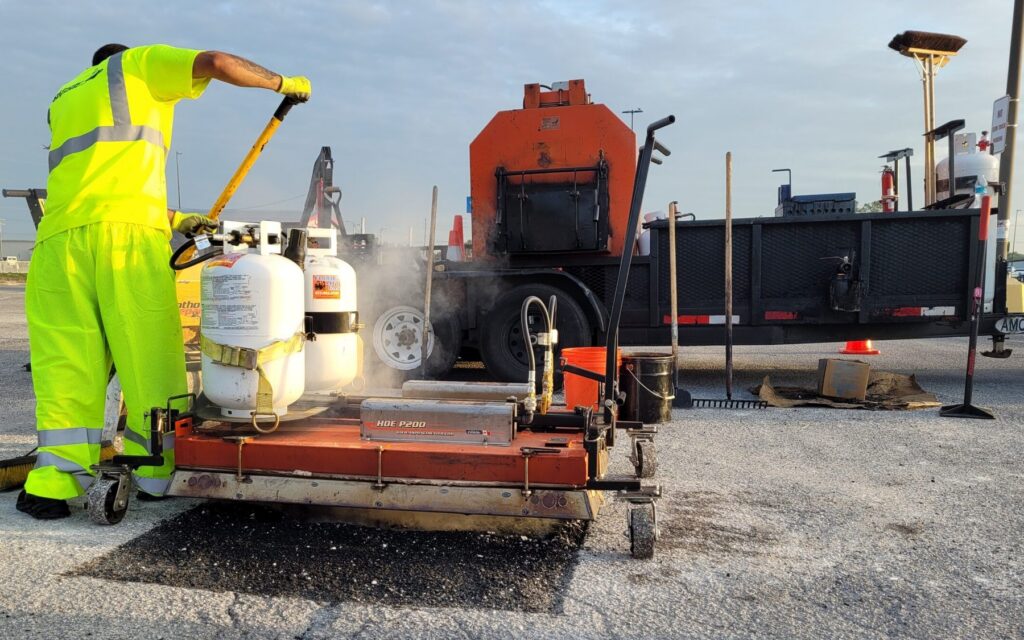
Yes. Infrared asphalt repair works in winter because the heat travels with the crew. The damaged area and the sound asphalt around it are heated in place, reworked and compacted into one surface, so the repair does not depend on an asphalt plant being open. Between December and March, that is the difference between fixing a pothole and plugging it.
It matters because winter is when potholes are made. Water works into cracks, freezes, expands and pries the surface apart, and traffic breaks out the loosened pieces during the next thaw. A crumbling edge in early January can be a tire-sized hazard by March. If the only winter option on the table is a shovel of cold patch, that hole gets plugged, reopens and gets plugged again before spring. This guide covers what still works in cold weather, what does not, and how to plan winter repairs across a Mid-Atlantic or Florida portfolio.
Key takeaways
- Infrared repair keeps working in winter because it heats and reworks the existing asphalt on site instead of waiting on plant-supplied hot mix.
- Asphalt plants close over the winter months, which is why traditional repair falls back on cold patch, a temporary material that never bonds to the pavement around it.
- The Federal Highway Administration treats winter patching as a way to restore safety and rideability, not as a permanent repair. Budget for that difference.
- No surface repair holds over a failed or saturated base. A winter inspection should separate surface potholes from base failures before anyone picks a method.
- Winter repair priorities are the places people and vehicles cannot avoid: entrances, fire lanes, accessible routes, drive-thru lanes and loading dock approaches.
Why Does Traditional Pothole Repair Stall in Winter?
Direct answer: Because it runs on hot mix asphalt delivered from a plant, and asphalt plants close over the winter months. Without hot mix, crews fall back on cold patch, a stockpiled material pressed into the hole. It restores a drivable surface quickly, but it never bonds to the surrounding pavement, so it is a temporary safety fix.
Traditional pothole repair is a supply chain problem as much as a pavement problem. The usual method cuts out the damaged area and fills it with hot mix that has to arrive at working temperature. When the plants shut down for the season, the hot mix goes with them, and what remains is cold patch.
The Federal Highway Administration’s pothole repair manual of practice is candid about what that means. It says the goal of winter patching is “to restore rideability and safety as quickly as possible,” not to repair the distress permanently. It notes that winter patches have a shorter life than spring patches, that good practice can stretch them from several days to several months, and that leaving a patch for traffic to compact leads to premature failure.
For a highway agency with thousands of lane miles, that trade makes sense. For a property manager, it means the pothole at the main entrance can be patched several times between Thanksgiving and April, with each visit billed and each reopening a fresh trip hazard. The weak point is always the same, and it is the reason asphalt patches fail at the seam.
How Does Infrared Repair Keep Working When Asphalt Plants Close?
Direct answer: The heat comes with the crew instead of from a plant. Our equipment heats the damaged area and the sound asphalt around it, the softened material is reworked and rejuvenated, fresh material is added where needed, and the area is compacted as one surface. There is no cold seam left for meltwater to get into.
Our infrared asphalt repair method is a Hot-In-Place recycling process. Rather than cutting out the damaged section and replacing it, we heat the existing asphalt and rework it so the repair fuses with the surface around it. One truck and a two-person crew complete most repairs in about 20 minutes, and the lot stays open while they work.
Winter is where the missing seam earns its keep. Look at a cold patch in February and you will usually see it lifting at the edge first. Meltwater runs along the joint between the patch and the old pavement, freezes overnight and pushes the patch up and out. That is the same freeze and thaw cycle that created the pothole in the first place. A repair that is fused into the surrounding asphalt gives the water no edge to work on. Over a sound base it behaves like the pavement around it, which is also what decides how long an infrared repair lasts.
There is a scheduling benefit too. Because the work does not wait on a plant calendar, a pothole that opens in the middle of January can be repaired permanently that month instead of being plugged and carried as a known hazard until spring.
What Winter Conditions Still Limit Any Asphalt Repair?
Direct answer: Active storms, water or ice sitting in the repair area, and a base that is frozen, saturated or already failed. Heat does not fix a soft base. If the pavement flexes under a truck, pumps water through its cracks after a thaw, or the damage runs below the asphalt layer, no surface repair will hold.
Year round service does not mean every day of the year. Nobody should be working a lot in the middle of a storm, and the federal manual points out that in winter conditions water is very likely to be sitting in the pothole. Ask any contractor, us included, which conditions stop work and how the crew deals with water in the hole. A vague answer to that question tells you a lot about the repair you are about to buy.
The bigger limit sits under the asphalt. A pothole surrounded by alligator cracking, a soft spot that moves when a delivery truck rolls over it, or a low area where water pumps up through the cracks after every thaw all point to a base that has lost support. Winter makes those failures obvious. It does not make them fixable from the surface. Those spots need base repair or reconstruction by a paving contractor, and we do not repave lots. When our inspection finds damage like that, the report says so plainly instead of selling you a surface repair that will not last.
When Is a Temporary Cold Fill the Right Winter Call?
Direct answer: When the hazard cannot wait for the next workable window. A hole that opens overnight at an entrance during a storm has to be made safe the same day, and a compacted cold fill does that. Treat it as a placeholder with a permanent repair scheduled behind it, never as the fix itself.
Our commercial asphalt repair options run from Permanent Thermal Repair through Semi-Permanent Hot Patch to Temporary Cold Fill. None of them is the right answer for every spot on every day, and after an inspection you choose the method for each repair around your priorities and budget. In winter the choice usually comes down to timing.
| Winter situation on the lot | Reasonable call |
|---|---|
| A pothole opens at the main entrance during a storm | Temporary cold fill the same day, permanent repair booked for the next dry window |
| A pothole in a drive lane during a cold, dry week | Permanent thermal repair now, before the next freeze and thaw cycle widens it |
| A raveling edge that is not yet a hole | Repair it now. In winter, loose edges become potholes fast |
| Several potholes over soft, flexing pavement | Make it safe, hold off on surface repairs and get the base assessed |
| A Florida lot with a backlog of repairs | Clear the list in the drier winter months, before the summer storm season |
A cold fill used well is compacted rather than left for traffic to pack down, logged with the date, location and photos, and replaced on a schedule. A cold fill used badly is the same hole refilled every few weeks with no record that anyone was watching it. If a slip or a damaged vehicle ever turns into a claim, that record is what you will be asked for, which is the whole idea behind claims-defense asphalt maintenance.
How Should Mid-Atlantic and Florida Lots Plan Winter Repairs?
Direct answer: Differently, because winter does different things to them. In Maryland, DC, Virginia, Delaware, New Jersey and Pennsylvania, winter is the damage season, so plan to repair through it during dry spells and thaws. In Florida, the drier winter months are the best window to clear the repair list before summer storms saturate the base.
Across the Mid-Atlantic, winter is when the year’s pothole damage is done. Every swing between freezing nights and above-freezing afternoons gives water another chance to pry the surface apart, and plow blades catch the raised edges of old patches and tear them loose. For properties around Washington DC, Baltimore and the Philadelphia metro, the practical plan is to clear known hazards in the fall, repair new holes permanently during dry spells through the winter, and inspect again once the thaw is over.
Florida runs on a different calendar. There is no freeze to worry about, but the summer wet season saturates the base under the asphalt and turns weak spots into potholes almost overnight. That makes the drier winter months the time to get ahead of it. Properties around Orlando and Tampa that clear their repair list between late fall and spring go into storm season with sealed surfaces instead of open edges for the rain to find.
What Should Be on Your Winter Repair Plan Before the First Freeze?
Direct answer: A walked inspection, a ranked repair list and a rule for mid-winter call-outs. Know which holes are surface damage and which sit over a failing base, choose the method for each, agree who calls the contractor when a new hole opens, and document every repair with the date, location and photos.
- Walk the lot in October or November. Mark every pothole, raveling edge and open crack near a traffic path. Small defects going into winter are the potholes coming out of it.
- Rank by exposure, not by size. Entrances, fire lanes, accessible parking and routes, drive-thru lanes and dock approaches come first. A large hole in a back row of stalls can wait longer than a small one at the front door.
- Separate surface damage from base failure. Surface repairs go on the winter list. Base failures need a different scope, and knowing which is which keeps you from paying twice.
- Choose a method and get the warranty in writing for each repair. Each repair tier carries its own warranty, so confirm the term on the proposal before you authorize work.
- Set the call-out rule. Decide who reports a new pothole, how fast it gets made safe, and when the permanent repair follows. The difference between emergency and planned repairs is mostly decided before the emergency.
- Book the spring inspection now. Our PARC Plan schedules inspections around your region’s stress season, right after freeze and thaw in the Mid-Atlantic, so new damage is caught at the cheapest moment to fix it.
Frequently Asked Questions About Asphalt Repair in Winter
Can potholes be repaired in the middle of winter?
Yes. Our thermal repair method is available year round because it does not depend on asphalt plants, which close over the winter months. Repairing through the winter keeps small potholes from growing across the freeze and thaw season. Work is scheduled around active storms and standing water, not around the calendar.
Is cold patch any good for a commercial parking lot?
It is good at one job: making a hazard safe quickly. Cold patch never bonds to the surrounding asphalt, so traffic and water work the edge loose and the hole comes back. Use it as a same-day stopgap with a permanent repair scheduled behind it, and keep a record of when and where it was placed.
How long does a cold patch last in winter?
Not long enough to budget around. The Federal Highway Administration’s pothole manual says winter patches have a shorter life than spring patches and that good practice extends them from several days to several months. On a busy commercial entrance, plan on the short end and schedule the permanent repair.
Will new asphalt bond to old asphalt in cold weather?
Not on its own. Cold material pressed against a cold pavement edge leaves a joint, and that joint is where meltwater gets in. Infrared repair solves it by heating the existing asphalt around the pothole along with the repair material, so the two are compacted together as one surface with no seam.
Should we wait until spring to fix parking lot potholes?
Not the ones people and vehicles cannot avoid. Every freeze and thaw cycle makes an open pothole larger, and every week it stays open at an entrance or on a walking route is a week of exposure to a trip or a damaged vehicle. Repair those through the winter and save lower-risk spots for a planned spring schedule.
Get Ahead of the Freeze and Thaw Season
Infrared asphalt repair in winter is not a workaround. It is the same permanent repair we make in May, done at the time of year when potholes are actually forming. Pair it with an honest read of what lies under the asphalt and a cold fill plan for the days nobody should be working, and your lot comes out of March in better shape than it went into December.
Want a winter repair plan for your property before the first hard freeze? Request your free inspection at potholerepair.com. We will walk the lot, rank every hazard by exposure, flag anything below the asphalt that a surface repair will not fix, and give you a written report you can act on.
