
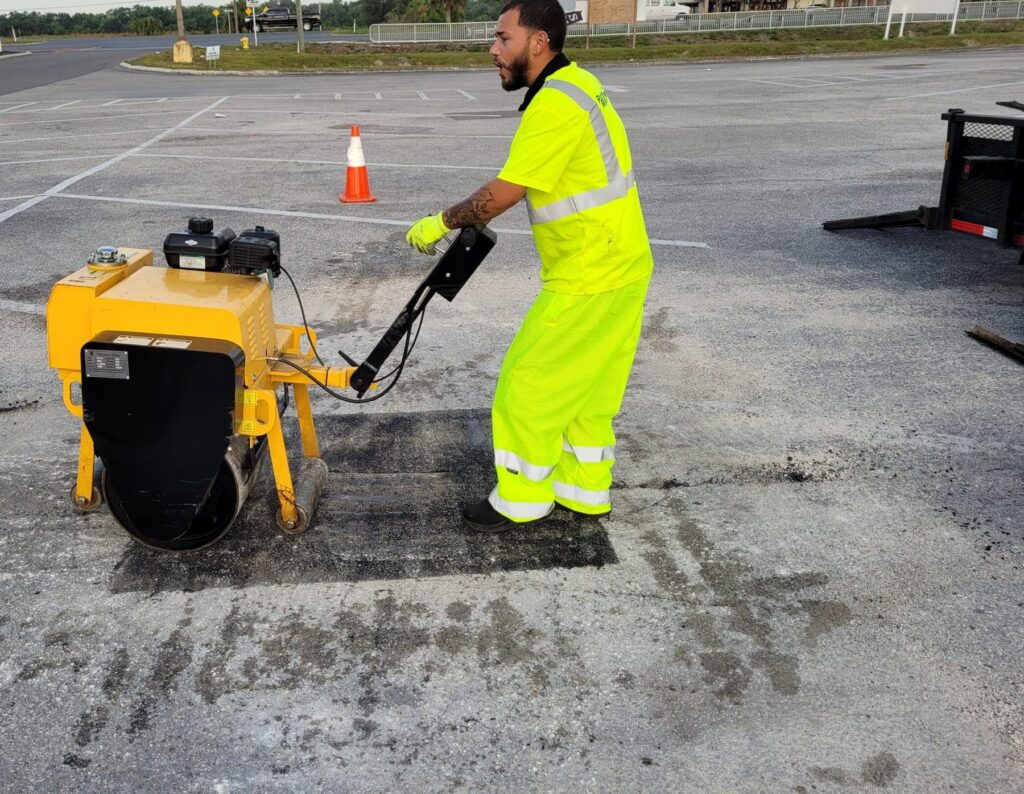
An infrared asphalt repair lasts as long as the base under it and the pavement around it stay sound. The heat fuses the repair into the existing asphalt, so there is no seam wearing out on a schedule of its own. When an infrared repair fails, the cause is almost always underneath it or next to it: a soft base, standing water, or pavement that was already breaking up.
That is not the tidy number a budget line wants. Search the question and you will find year ranges quoted with confidence, averaged across highways, city streets and parking lots that have almost nothing in common. A facility manager planning repairs across one lot or forty needs different answers: what will shorten this repair on my property, where will it wear first, and what term can I hold the contractor to in writing? That is what this guide covers.
Key takeaways
- An infrared asphalt repair has no fixed expiry date. It is thermally bonded into the surrounding asphalt, so its service life follows the condition of the base and the pavement around it.
- Four conditions end infrared repairs early: a base that has lost support, water that sits on or beside the repair, damage deeper than the asphalt layer, and surrounding pavement that is already failing.
- Drive-thru lanes, dumpster pads, loading dock approaches and entrance aprons wear repairs far faster than parking stalls, so they deserve the closest and most frequent inspection.
- The only service-life figure you can budget against is the warranty term written on the proposal. Get it per repair and per method before any work starts.
- Inspections timed to the season that stresses your pavement most, freeze-thaw in the Mid-Atlantic and the wet season in Florida, catch the conditions that shorten repairs before they become new potholes.
How Long Does an Infrared Asphalt Repair Last on a Commercial Lot?
Direct answer: As long as the base and surrounding pavement stay sound. An infrared repair is heated, rejuvenated and compacted into the existing asphalt as one surface, so it has no seam of its own to fail. On a stable base with working drainage it is a permanent repair. Over a failing base, no surface repair lasts.
Most repairs are sold as an object with a lifespan, like a roof or a water heater. An infrared asphalt repair does not work that way, because once it is done there is no separate object left. The heater softens the existing pavement in and around the pothole. The crew rakes it, works in DOT approved hot mix asphalt and hot asphalt cement to rejuvenate and bind the old material, levels it, and compacts it. When it cools, the repaired area and the pavement around it are one continuous surface.
So the honest answer to “how long” is a question back: how long will the ground under that spot keep supporting it? On a lot with a sound base and water that drains away, a properly installed thermal repair is intended to be the last repair that spot needs. On a lot where the base is soaked or broken, the best surface repair in the world is buying time.
The year ranges you will find online are general guidance drawn from very different pavements, not a specification for your property. The number that belongs in your budget is the warranty term on the proposal, because it is the only one you can enforce.
Why Does an Infrared Repair Outlast a Conventional Patch?
Direct answer: Because it removes the joint. A conventional patch places new material against colder, older pavement and leaves a seam that water eventually opens. An infrared repair heats the surrounding asphalt first, so the repair and the pavement around it cool and harden together with no edge for water to follow.
We covered the seam in detail in why asphalt patches fail at the seam, so the short version here. Water gets into the joint around a conventional patch. In Washington DC and Baltimore, it freezes overnight and thaws by lunch, prying the joint wider each cycle. In Orlando and Tampa, there is no freeze, but daily wet-season storms keep that joint soaked for months. Either way the edge goes first.
Compaction is the other half of it. The Federal Highway Administration’s pothole repair manual of practice is blunt: leaving a patch to be compacted by traffic “will result in premature patch failures.” A thermal repair is rolled tight while the whole area is still hot, so the density is built in before the first car drives on it.
What Shortens the Life of an Infrared Asphalt Repair?
Direct answer: Four conditions, and none of them is the repair itself: a base that has lost support, water that ponds on or beside the repair, damage that runs deeper than the asphalt layer, and surrounding pavement that is already cracking apart. Workmanship is the fifth, which is why rejuvenation and roller compaction matter so much.
| Condition | What it does to the repair | What to look for |
|---|---|---|
| Soft or broken base | The surface flexes over ground that moves, and cracks no matter how well it is bonded. | A repair that sinks evenly, or fine interconnected cracking spreading around it. |
| Standing water | Water held against pavement softens the base and works into every small crack. | Puddles hours after rain, clogged inlets, downspouts emptying onto the lot. |
| Damage below the asphalt | A surface repair over a hole in the base has nothing solid to sit on. | A pothole where you can see or feel loose stone or soil at the bottom. |
| Failing pavement around it | The repair bonds to its neighbors. If they are breaking up, the edge of the sound area becomes the new weak line. | Raveling, loose stone and wide cracking just outside the repaired area. |
| Poor workmanship | Scorched asphalt, no rejuvenation, or light compaction leaves a brittle or porous surface. | A dull, crumbly texture or a repair that ruts within weeks. |
Notice that four of the five rows describe the lot, not the repair. That is why two identical repairs on the same property can age very differently, and why the useful response to an early failure is to find the cause before paying for the same spot again.
Where on a Commercial Lot Do Repairs Wear Out Fastest?
Direct answer: Wherever heavy wheels brake, turn or stand still. Drive-thru lanes, dumpster pads where refuse trucks set down, loading dock approaches, entrance aprons and school drop-off loops all load a repair far harder than a parking stall does. Inspect those areas first and most often, and expect them to need attention sooner.
A parked car sits on a stall for an hour and leaves. A refuse truck lands its full weight on the same few square feet of a dumpster pad every collection day, then twists its tires as it pulls away. Delivery trucks brake into the same dock approach dozens of times a week. Every car entering a retail center turns across the same apron. Those are the spots where a bonded repair earns its keep, and also where you will see wear first.
Climate adds its own layer. In the Mid-Atlantic, plow blades catch any raised edge over the winter, and meltwater runs across the lot for weeks. In Florida, summer heat softens asphalt, and a loaded truck parked in the same spot every afternoon leaves its mark. Mapping these high-stress zones on your property tells you where to inspect after every season and where a temporary fix will never be good enough.
When Is Infrared the Wrong Repair for the Job?
Direct answer: When the problem is below the asphalt. Base failure, widespread fatigue cracking, depressions from undermined drainage and large areas of broken pavement need structural work first. A good contractor says so before selling a surface repair, and puts it in the condition report instead of patching over it.
This is where you find out who you are dealing with. A surface repair over a failed base looks perfect the day it goes in, and the crew is long gone when it sinks. We would rather tell you up front that a spot is out of our scope, note it in your report, and point you to the right kind of contractor for it. That is part of how we inspect, and it is the same thing we do under a PARC Plan, which includes identifying out-of-scope damage on every visit.
Infrared is also not the only tool on our menu. Our commercial asphalt repair options run from Permanent Thermal Repair through Semi-Permanent Hot Patch to Temporary Cold Fill. Cold fill has one honest job: removing a hazard quickly until a permanent repair can be scheduled. The FHWA manual says the same thing about winter patching, that the goal is to restore rideability and safety quickly, not to repair the distress permanently. If a proposal presents cold fill as a lasting fix, ask why.
What Should the Proposal Say So You Can Hold the Repair to It?
Direct answer: Everything you would need to prove a repair failed early: each repair’s location, measured size and method, before and after photos, the warranty term for that method, what voids it, and how a warranty call is logged and answered. Without those details, an early failure is your cost, not the contractor’s.
Repair life is only enforceable if it is written down per repair. “Lot repairs, warrantied” tells you nothing when one of twelve patches opens up next spring. A numbered repair map with photos does. Our inspections produce an interactive report where you choose the method for each repair, see the warranty that comes with it, set priorities against your budget and authorize the work. Each repair tier carries its own warranty, so the choice of method is also a choice of how long you are covered.
If you bid work across several properties, these items belong in your commercial asphalt repair scope of work. The same records also protect you on the liability side, which we cover in claims-defense asphalt maintenance.
How Do You Get the Longest Life From Repairs Across a Portfolio?
Direct answer: Repair early, inspect on a schedule, and fix what is working against the repair. A small pothole repaired before it widens keeps the bonded area inside sound pavement. Inspections after your region’s hardest season catch ponding and edge breakup early. A PARC Plan builds that schedule in and extends repair warranties.
Timing matters more than most budgets allow for. A pothole left open over a Mid-Atlantic winter grows, and the pavement around it weakens, so the eventual repair is bigger and sits in poorer asphalt. Asphalt plants close for the winter, which stalls traditional hot mix repairs, but our thermal method is available year round. Here is how infrared asphalt repair works in winter. That means you do not have to leave a hazard open until spring.
Across a portfolio, the pattern is simple. Walk every property after its stress season, repair the small failures while they are small, and deal with drainage and base problems as their own line items instead of paying to patch over them. PARC Plan members get inspections scheduled around those seasons, discounts on repairs, and warranties extended by an additional 25 percent. For a parking lot pothole repair program, that is how an infrared repair gets the full life the pavement allows.
Frequently Asked Questions About Infrared Repair Life
Does infrared asphalt repair work on busy commercial lots?
Yes. It is well suited to potholes and surface failures in asphalt over a sound base, including drive lanes and entrances with heavy daily traffic. Because the repair is compacted while hot and bonded into the surrounding pavement, it handles turning and braking loads better than a conventional patch. It cannot fix a failed base underneath.
Is an infrared repair as strong as the pavement around it?
It becomes part of that pavement. The existing asphalt is heated, rejuvenated with hot asphalt cement, topped up with hot mix where needed and compacted, so there is no joint between old and new. That also means it is only as strong as its surroundings. Over sound pavement it performs like sound pavement.
How quickly can traffic use an infrared repair?
Most of our thermal repairs take about 20 minutes with one truck and a two-person crew. The area goes back into use once the repair is compacted and the crew has cleared the work zone, so tenants, guests and deliveries are not locked out of the lot for the day.
What warranty should come with an infrared asphalt repair?
A written term for each repair, tied to the method used, with the conditions that void it and the process for making a claim. Our repair tiers each carry their own warranty, and a PARC Plan extends them by an additional 25 percent. Confirm the exact term on your proposal before you authorize work.
How often should infrared repairs be inspected?
At least once a year, right after the season that stresses your pavement most: late winter or early spring in the Mid-Atlantic, and after the summer wet season in Florida. High-stress zones such as dumpster pads, dock approaches and drive-thru lanes are worth a look more often.
Budget for the Repair That Stays Fixed
An infrared asphalt repair does not come with a countdown clock. It lasts as long as the lot underneath it is allowed to, which puts most of its service life in your hands and in the honesty of whoever inspects your property. Get the causes found, the repair method chosen per spot, and the warranty written per repair, and you will stop paying for the same pothole twice.
Want to know how long the repairs on your property should last and what is working against them? Request your free inspection at potholerepair.com. We will walk the lot, map the high-stress zones, flag anything below the asphalt that a surface repair will not fix, and give you a written report you can act on.
