
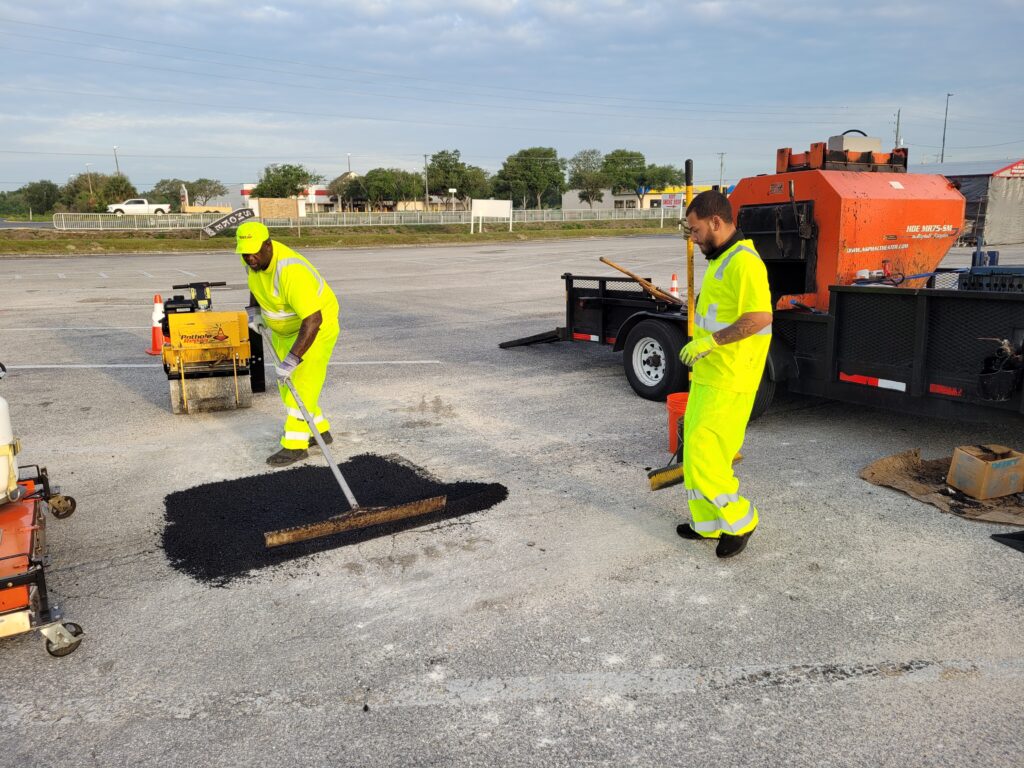
A property manager signs off on a pothole repair in the spring. By the next winter there is a dark ring in the same spot, then a thin crack tracing the outline of the old patch, then a hole again. The middle of the patch usually still looks fine. It was the edge that let go. We see that pattern on commercial lots up and down the Mid-Atlantic every thaw, and it is the most common reason facility teams tell us they feel like they keep paying for the same pothole.
The seam, where new material meets the old pavement, is the weak point of almost every conventional patch. Once you know why it fails and what a failing seam looks like, you can work out whether you bought a poor installation or whether the lot has a deeper problem that no surface fix will cure. You will also know exactly what to require the next time a crew shows up.
Key takeaways
- Most conventional asphalt patches fail at the seam first, where new material sits against older, colder pavement without truly bonding to it.
- A crack tracing the patch outline, crumbling stone along the edge, or a small step at the perimeter means the seam has opened and water is getting underneath.
- Patching over water or debris, leaving ragged edges, skipping a tack coat, and under-compacting the material all weaken the seam before the crew leaves.
- When a patch sinks evenly or cracking spreads well past its edges, the base or drainage has failed, and a surface repair alone will not hold.
- Thermal bonding heats the surrounding asphalt so the repair and the existing pavement cool as one surface, which removes the cold seam water follows.
Where Does a Commercial Asphalt Patch Usually Fail First?
Direct answer: At the seam. The perimeter where fresh material meets the existing pavement is almost always the first part of a conventional patch to open. The center is held in place by material on every side. The edge is a joint between two separate pieces of asphalt, and joints are where water and traffic get in.
A conventional patch is a plug. Material goes into the hole, gets compacted, and the center is squeezed from all directions. The edge has pavement on only one side, and that pavement is older, oxidized, and usually much colder than the mix going in. The two surfaces touch. That does not mean they bond.
Where the patch sits matters too. Drive lanes, the approach to a loading dock, the turn into a drive-through, and anywhere tires brake or turn all work that joint far harder than a parked stall does. That is why a patch in a quiet parking row can hold for years while an identical patch at the main entrance is breaking up by the next thaw.
Why Does the Seam Let Water In?
Direct answer: Conventional patches leave a cold joint. Hot mix placed against cold, aged pavement cools before it can fuse with it, leaving a hairline boundary between old and new. Water follows that line down, softens the base, and in freezing weather expands and pries the edge a little further open with every cycle.
In Washington DC and Richmond, winter does not stay frozen. It freezes overnight, melts by lunch, and does it again. Every one of those swings pushes water that got into the seam to expand and contract, and every one of them widens the gap for the next rain. A seam that was a hairline in November can be a finger-width crack by March.
Florida lots skip the freeze but not the problem. Heavy afternoon storms put water on the pavement almost daily through the wet season, and lots with poor drainage hold it against the patch edge for hours. Add summer heat that softens asphalt and delivery trucks turning on it, and a weak seam in Fort Lauderdale fails for a different reason on a similar timeline. The same is true of asphalt patching in Fort Myers, where the rainy season tests every seam a cold patch leaves behind.
What Does a Failing Patch Seam Look Like?
Direct answer: Look for a thin crack tracing the patch outline, loose stone or crumbling along the edge, a small step up or down where patch meets pavement, and dark damp staining around the perimeter after rain. Any one of these means the seam has opened and the next pothole is already forming underneath.
You do not need a core sample to read a patch. Walk the perimeter after a rain and look for these patterns, because each one points to a different cause.
- A crack that traces the outline. The joint has separated. Water is getting in now, and the repair has started to fail even if the surface still looks solid.
- Loose stone or crumbling at the edge. Usually a thin, feathered edge that was never thick enough to hold, or material that cooled before it was compacted.
- A step at the perimeter. The patch has settled below the old pavement or was left high. Either way it is a trip hazard on any walkway and a shock load every time a tire drops over it.
- A dished center or ruts. The material was under-compacted, and traffic is finishing the job the crew did not.
- The whole patch lifting out. There was no bond at all. This usually means it went in over standing water, dust, or loose debris.
Which Installation Shortcuts Weaken the Seam?
Direct answer: Patching into standing water or loose debris, leaving ragged or feathered edges, skipping a tack coat on the existing walls, placing material too thick to compact properly, and letting the mix cool before it is rolled. Each shortcut saves a few minutes on the day and takes seasons off the life of the repair.
Most seam failures are decided before the truck leaves. A crew that shovels mix into a wet hole full of broken aggregate is sealing water and debris into the joint. Ragged edges leave thin slivers of new material that crumble under the first heavy tire. Without a tack coat, there is nothing encouraging the new mix to stick to the old walls. Material placed in one deep lift cannot be compacted all the way down, so it keeps settling under traffic and pulls away from the edge as it goes.
Then there is the throw-and-go cold patch, compacted by whatever cars happen to drive over it. Cold mix has a legitimate use as a short-term safety fill until a proper repair can be scheduled. It should be priced, documented, and understood as temporary. The trouble starts when a temporary fill gets logged as a completed repair and nobody comes back.
When Is a Failed Patch Not the Patch’s Fault?
Direct answer: When the failure is below the surface. If a patch has sunk evenly, if the pavement around it shows interconnected cracking well past its edges, or if water ponds on that spot after every storm, the base or drainage has failed. Any surface repair placed over that condition will struggle, however well it is installed.
This is the part most repair pitches skip. A seam failure is a surface problem with a surface solution. A soft base, a clogged drain inlet, or water running off a roof leader onto the same corner of the lot is not. Patch over it and you will be back, whichever method you use.
A proper inspection should tell you which situation you are in before anyone quotes a repair. When we walk a lot and find base or drainage problems that pothole repair cannot solve, we say so in the condition report instead of patching over them, and we can refer you to a partner for work outside what we do.
How Does Thermal Bonding Stop Seam Failure?
Direct answer: It removes the cold joint. A thermal repair heats the existing asphalt around the damage until it softens, then the recycled material, fresh hot mix, and asphalt cement are worked together and compacted. The repair and the surrounding pavement cool as one continuous surface, leaving no seam for water to follow.
The difference is in what happens at the edge. A conventional patch puts hot material next to cold pavement. Infrared asphalt repair heats the pavement first, so by the time new material goes in, the old asphalt around the hole is soft enough to blend with it. The existing asphalt is rejuvenated and reused in place, topped up with DOT-approved hot mix, and compacted as a single piece. There is no boundary line left for water to find.
That is why our commercial asphalt repair options are built around the seam. The Permanent Thermal Repair is the bonded fix and the right choice when you want the pothole gone for good. The Semi-Permanent Hot Patch uses hot mix without the full thermal bond and makes sense when budget is tight. Temporary Cold Fill is exactly what it says, and we rarely recommend it except as a short-term safety measure. The work runs inside a coned zone without closing the lot, so a busy entrance does not have to go dark to be fixed properly.
What Should You Require Before Approving an Asphalt Patch?
Direct answer: Ask how the edges will be prepared, whether the new material will be bonded to the existing pavement, how water and debris will be cleared, how the repair will be compacted, and what the warranty covers if the seam opens. Then walk the perimeter of every repair after its first wet or freezing season.
Put those questions in writing before anyone prices the job. If you are bidding repairs across several properties, they belong in the method and acceptance sections of your asphalt repair scope of work, so every contractor is answering the same question and you can tell a bonded repair from a fill on paper.
After the work is done, the seam is what you inspect. A repair that still shows a tight, invisible edge after a winter was installed properly. One with an outline crack in its first season was not, and that is a warranty conversation, not a new purchase order. For lots where the same spots keep coming back, our guide to long-term parking lot pothole repair covers the maintenance side, and the PARC Plan puts planned inspections on a schedule so a separating seam gets caught while it is still a hairline.
Frequently Asked Questions About Asphalt Patch Failure
How long should a commercial asphalt patch last?
It depends on the method, the traffic, and the base underneath. Cold fill is a short-term measure. A hot patch is semi-permanent. A thermally bonded repair over a sound base is intended as a permanent fix. Whatever you buy, get the warranty term in writing before work starts. For the thermal method in detail, see how long infrared asphalt repair lasts.
Why does a new patch stay soft or rut under traffic?
Usually the material was not compacted enough, went in too cool, or is cold mix that never fully set. Summer heat makes it worse in turning lanes and at dock approaches. A repair that ruts within weeks was installed poorly and should be addressed under the contractor’s warranty.
Can a failing patch be fixed, or does it have to come out?
If only the seam has opened and the base is sound, a thermal repair can often heat the old patch and the surrounding pavement and bond them into one surface. If the patch is lifting out or the base below has failed, the loose material has to come out first.
Should potholes be repaired in winter if patches can fail?
Yes. A pothole left open all winter grows and stays a hazard for drivers and pedestrians. Thermal repair can be done year round, and where conditions call for it, a temporary fill removes the hazard until a permanent repair is scheduled and documented.
What are the signs an asphalt repair was done badly?
An outline crack in the first season, loose stone along the edge, a step where the patch meets the old pavement, water sitting on the repair after rain, or a patch that has dropped below the surrounding surface within a few weeks. Photograph it and raise it with the contractor.
Stop Buying the Same Pothole Twice
A patch that fails at the seam was never really finished. The hole got filled, but the joint that lets water back in was left in place. Fixing that joint, and being honest when the real problem is underneath it, is the difference between a repair and a return visit.
If your lot has patches showing outline cracks or crumbling edges, request your free inspection at potholerepair.com. We will walk the property, tell you which failures are seam problems and which are not, and give you a written condition report for your parking lot pothole repair planning. Request your free inspection to get started.
