
A hotel parking lot is the first thing a guest touches and the last thing they remember. Long before anyone sees the lobby, they have already driven the entrance, taken the turn toward the porte-cochere, and rolled a suitcase across whatever surface you have. When that surface has a pothole in the drive lane or a broken edge at the crosswalk, the arrival is compromised, and so is your liability exposure.
The problem for hospitality operations teams has never been recognizing the damage. It is finding a way to fix it that does not take parking offline. A hotel cannot close its lot for three days the way a warehouse can. Rooms are sold, shuttles run on a loop, banquet load-in happens whether or not the pavement is ready. That constraint is exactly why hotel and lodging properties put off pavement work until it becomes an emergency.
Key takeaways
- A hotel lot can be repaired zone by zone while the property stays open. The lot never closes, only the work area does, and it moves.
- Thermal asphalt repairs are finished and open to traffic once the patch is compacted and cooled, so a repair does not carry over into the next shift.
- Repair preserves the asphalt you already paid for. Repaving a hotel lot means closed parking, displaced guests, and rooms you cannot sell.
- Pavement condition shows up in franchise brand-standard reviews and property improvement plans, which makes it an operations issue before it is a maintenance issue.
- Hospitality groups with several properties should scope repairs across the portfolio, not one hotel at a time, so every site is held to the same standard.
Why do hotel parking lots fail faster than other commercial lots?
Direct answer
Hotel lots fail early because the traffic is concentrated, heavy, and repetitive. Shuttles, delivery trucks, and rideshare vehicles follow the same path hundreds of times a week, loading the same few feet of asphalt at the entrance, the porte-cochere approach, and the turn into the loading area.
Most commercial lots spread wear across the whole surface. A hotel does not. Guest vehicles scatter, but the vehicles that do real damage travel a fixed route. Airport shuttles pull in and out on a schedule. Linen and food service trucks hit the same service entrance every morning. Rideshare drivers stack in the same twenty feet of curb line because that is where the app drops the pin.
Add water to that pattern and the failure accelerates. Wherever a drive lane dips, water sits, and where water sits through a freeze-thaw cycle in the Mid-Atlantic or through a summer of Florida downpours, the base under the asphalt starts to move. The pothole you see in March was a soft spot in November. That is why the same three or four locations on a hotel property keep breaking no matter how many times someone throws cold patch in the hole.
Can a hotel parking lot be repaired without closing it?
Direct answer
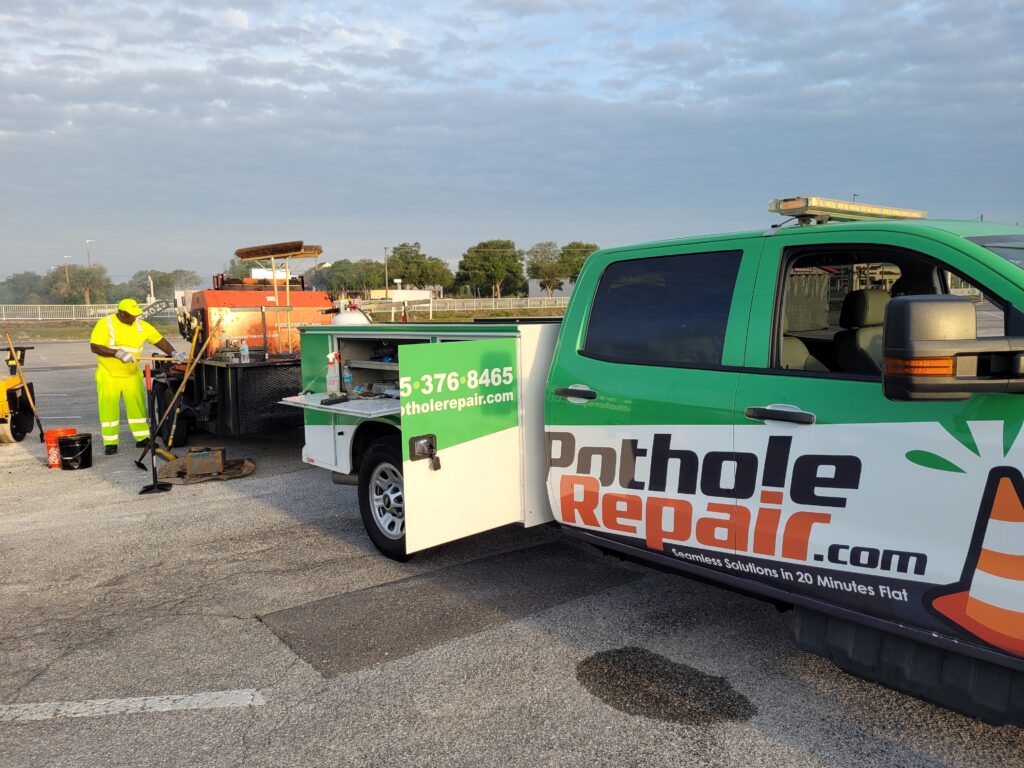
Yes. The lot stays open and the work zone moves. Crews cone off one repair area at a time, complete it, then relocate. Because a thermal repair reaches full compaction on site, that section reopens to traffic the same shift instead of waiting on cure time.
This is the part that surprises most general managers. They picture a repave: barricades, a closed section for days, a smell that reaches the third floor, and a lot of angry guests. That is a different job entirely. A thermal asphalt repair heats and reworks the existing material in place, so the footprint is the size of the failure, not the size of the lot. Our parking lot pothole repair service is built around that footprint discipline.
In practice, a repair area is a coned rectangle a few parking stalls wide. Guests drive around it the way they drive around a delivery truck. When the crew finishes, the cones move to the next spot. Nobody is turned away from parking, and no one has to reroute the shuttle for a week.
How do you schedule asphalt repairs around check-in, check-out, and events?
Direct answer
Work the quiet windows. Late morning after check-out and early afternoon before check-in are the lowest occupancy hours in the lot on most properties. Crews stage early, hit the heavy zones first, and clear the entrance and porte-cochere before the afternoon arrival wave begins.
Good scheduling starts with your own data, not a contractor’s calendar. Before the crew arrives, an operations team should be able to say when the lot is emptiest, when the shuttle runs, which day the linen truck comes, and what is on the banquet calendar. A wedding block on Saturday means the entrance drive gets repaired Thursday, not Friday night.
Two rules keep it clean. First, never take the accessible route and the accessible stalls out of service at the same time as the main entrance. Sequence them. Second, protect the arrival path above everything else. A guest can walk an extra thirty feet in the back of the lot without noticing. They will absolutely notice a coned-off porte-cochere at four in the afternoon.
Overnight work is available and sometimes right, particularly at airport properties where the arrival curve never really flattens. It is not automatically better. Lighting, noise near guest rooms, and reduced visibility all cut against it, so treat overnight as a tool for specific properties rather than the default answer.
What does a phased repair plan look like on a hotel property?
Direct answer
A phased plan divides the property into zones by function: arrival and porte-cochere, guest parking, service and loading, and the perimeter drive. Each zone is inspected, priced as its own scope, and scheduled in a sequence that keeps at least one clear route to the front door at all times.
Zoning matters more than the repair count. A scope that lists thirty defects across a property tells you nothing about how the work will land on operations. The same thirty defects grouped into four zones with a sequence tells the GM exactly what changes on which day.
The zone that almost always gets missed is the service side. Housekeeping carts, dumpster pulls, and grease trap service all happen on pavement nobody photographs, and it is usually the most broken asphalt on the property. It is also where a heavy truck can drop a wheel into a hole and take out a dumpster enclosure gate on the way through. Put the service side in the scope before it becomes an emergency call.
If your property already runs a maintenance calendar, the same logic applies to pavement. Our PARC Plan exists for exactly this reason: scheduled inspections and planned repairs are the difference between a work order and a crisis. The economics of that choice are covered in more depth in our breakdown of emergency versus planned parking lot repairs.
When does a hotel need repair instead of repaving?
Direct answer
Repair is the answer when the failures are isolated and the base is sound, which describes most hotel lots. Repaving is warranted only when deterioration is continuous across the surface and the underlying base has failed broadly, and it should be proven with an inspection, not assumed.
We are not a paving company and we do not repave lots. We repair and save the asphalt that is already there, which puts us in an unusual position: we are frequently the ones telling a property that the repave quote sitting on their desk is solving a problem they do not have. A lot with fifteen distinct failures and a solid base does not need a new surface. It needs fifteen repairs and a plan that keeps new ones from forming.
The hospitality math makes this sharper than it is in other verticals. Repaving takes parking out of service, and parking out of service at a hotel means rooms you cannot sell, groups you cannot host, and a shuttle route you have to redraw. Those costs never appear on the paving bid, and they are frequently larger than the difference between the two approaches.
How does pavement show up in brand standards and PIP inspections?
Direct answer
Franchisors evaluate the arrival experience, and pavement condition is part of it. Broken asphalt, faded striping, and standing water in the drive lane get written up in brand-standard reviews and can land in a property improvement plan, which converts a deferred repair into a mandated capital item.
This is the argument that unlocks budget when nothing else does. A pothole is easy to defer because it does not generate a bill. A brand-standard finding does generate one, on a deadline, with a franchisor watching. Ownership groups that understand the sequence stop treating pavement as discretionary.
The guest-facing version of the same risk lives in reviews. Arrival and departure bracket the entire stay, and a rough entrance colors both. You do not need a study to know that a review mentioning the parking lot is a review the revenue team has to answer.
What should a hospitality group ask an asphalt repair contractor?
Direct answer
Ask how the work zone moves, how long each repair area stays closed, whether the crew can work around your check-in and event calendar, how the accessible route is maintained, and whether the same scope and standard can be applied across every property in the portfolio.
Push on the scope document itself. An itemized scope names each defect, its location, its repair method, and its zone. A single line that reads “asphalt repairs as needed” is not a scope, it is a blank check, and it makes phasing impossible because nobody can tell which repair belongs to which day.
For groups managing several properties, insist on consistency. A regional portfolio should be inspected against one standard so that a defect flagged at your Orlando property is flagged the same way at your Baltimore property. We work across the Mid-Atlantic and Florida, including Orlando and Tampa, which are two of the most shuttle-heavy hospitality markets in the country. The full range of commercial asphalt repair solutions is built around that kind of multi-site consistency, and the approach mirrors what we recommend for HOA and condo boards budgeting shared-lot repairs.
Start with an inspection and a real scope. Request your free inspection at potholerepair.com and we will walk the property, zone it, and give you a sequence your operations team can actually run.
Frequently asked questions
Can guests keep parking while the repair is underway?
Yes. Only the active repair area is coned off, usually a few stalls at a time, and it relocates as the crew progresses. Guests park normally in the rest of the lot, and the arrival route to the front entrance is kept open throughout the work.
How long does a single hotel parking lot repair take?
Individual repairs are completed and reopened within the same work window. Thermal repairs reach full compaction on site, so there is no cure time to wait out and no need to leave a section barricaded overnight. Total time on property depends on how many defects are in the scope.
Do you work overnight or before check-in?
Both are available. Most properties get the best result from early and mid-day work, when the lot is emptiest between check-out and check-in. Overnight scheduling makes sense at airport and high-occupancy properties where there is no daytime lull, and it is planned around guest-room proximity and lighting.
Which hospitality markets does PotholeRepair.com serve?
We serve commercial and hospitality properties across the Mid-Atlantic, including Maryland, Washington DC, Virginia, Delaware, New Jersey, and Pennsylvania, plus Florida. Multi-property groups can be scoped and scheduled across markets under one standard.
Is repairing better than repaving a hotel lot?
When failures are isolated and the base is sound, repair is both faster and less disruptive, and it saves the asphalt already in place. Repaving requires taking parking out of service for days, which carries operational costs that rarely appear on the paving bid.
