
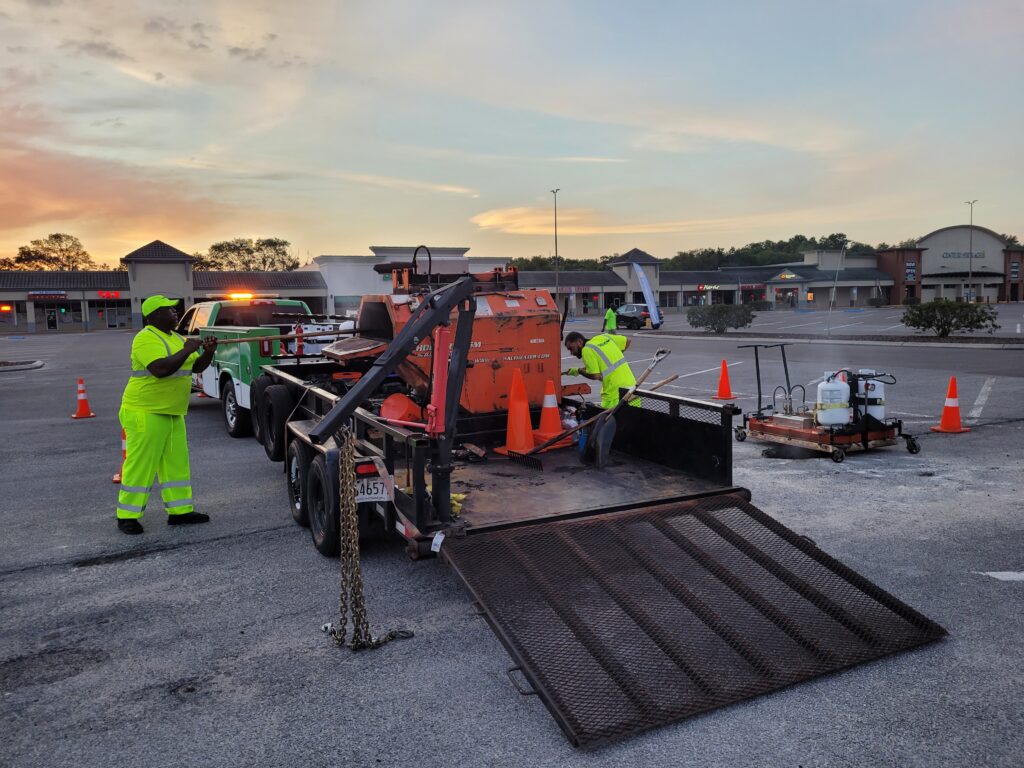
A pothole in a school bus loop and a pothole outside a senior living entrance are the same physical defect, and neither one behaves like a pothole at a warehouse. The people crossing it are children moving in groups, or residents using a walker, a cane, or a wheelchair. The margin for a stumble is gone. That is the part facilities directors on these campuses understand instinctively and struggle to get funded before something happens.
The second problem is the calendar. A distribution center can close a lane for two days. A school district has a bell schedule, a bus fleet that arrives within a fifteen minute window twice a day, and parents who queue in the same lane every afternoon. A senior living community has no break at all. Medical transport, family visits, dining deliveries, and emergency vehicles run every day of the year. Those two constraints, vulnerable pedestrians and a schedule that never opens up, are what make schools and education campuses and senior living communities their own category of pavement problem.
Key takeaways
- Campus pavement failures cluster in predictable places: the bus loop, the fire lane, the accessible route from the parking spaces to the entrance, and the trash and delivery approach.
- A pothole or a broken edge sitting in an accessible route is a compliance exposure, not only a trip hazard. Under the 2010 ADA Standards, a change in level above half an inch has to be ramped rather than left as an abrupt edge.
- Campus lots can be repaired zone by zone while the site stays open. Only the active work area is coned, and it moves as the crew progresses.
- Thermal repairs are compacted and opened to traffic in the same work window, so nothing stays barricaded overnight in front of a school entrance or an ambulance approach.
- Waiting for summer break is a workable plan for a school and a bad one for senior living, where there is no low season and defects keep growing through the winter.
Why do school and senior living campuses carry more pavement risk than other commercial sites?
Direct answer
Because the pedestrians are the least able to recover from a misstep and the traffic is the most repetitive. Children walk in distracted groups, residents use mobility devices with small wheels, and buses and medical transport vehicles load the same few feet of asphalt on a fixed route every single day.
Most commercial properties spread wear across the surface. Cars arrive from different directions, park in different rows, and leave. A campus does not work that way. A school bus enters at the same point, follows the same arc through the loop, stops at the same curb, and does it twice a day, roughly a hundred and eighty days a year, with a vehicle that weighs far more than anything else on the property. Senior living has the same pattern in a different shape. Medical transport vans and ambulances use one approach to one canopy, and that approach takes the load.
Then there is who is walking on it. A car tire rolls straight over a defect that will catch the front caster of a wheelchair or the tip of a walker. The failure that a facilities director at an industrial site can reasonably defer is the same failure that produces an incident report on a senior living campus. This is why the risk conversation on these properties starts earlier and gets escalated faster than it does anywhere else in commercial real estate.
Where do potholes actually form on a campus, and why there?
Direct answer
Failures concentrate where heavy vehicles turn, stop, and stand: the bus loop apron, the fire lane, the dumpster and delivery approach, and the canopy drive at the main entrance. Water then finds the crack, saturates the base, and freeze and thaw cycles or heavy rain open it into a pothole.
Walk any campus and the map is the same. The bus loop shows rutting and edge break where buses turn under load, because a turning axle grinds sideways instead of rolling. The dumpster pad approach fails because a loaded refuse truck stops, lifts, and sets down in one spot. The fire lane fails quietly, since nothing drives it until the day something has to.
The mechanism underneath is always water. A hairline crack lets water into the base. In Maryland, Virginia, Delaware, New Jersey, and Pennsylvania, that water freezes, expands, and lifts the pavement, then thaws and leaves a void that collapses the next time a bus rolls over it. In Florida the freeze never comes, but summer storms saturate the base repeatedly and the same void forms from the bottom up. Different climate, identical result, which is why a campus in Rockville and one in Sarasota both end up with the same defect at the same spot in the loop.
Can a campus lot be repaired without closing it?
Direct answer
Yes. The lot stays open and only the active repair zone is coned, typically a few stalls or one section of drive lane at a time. The work area moves with the crew, and each repair is compacted and reopened to traffic before the crew leaves that spot.
This is the difference that decides whether a campus gets its pavement fixed or defers it another year. We are not a paving company and we do not repave lots. We repair the asphalt that is already there using thermal asphalt repair, which heats the existing pavement in place, reworks it with the surrounding material, and compacts it back into a bonded surface. There is no cold seam around the patch for water to get back into, and there is no cure window to wait out. It is the same process behind our parking lot pothole repair service for commercial properties of every kind.
Practically, that means a crew can work the bus loop between the morning drop off and the afternoon pickup and be off that section before the first bus returns. On a senior living campus it means the canopy approach is coned for a portion of the morning and open for the afternoon transport runs. Nothing sits barricaded overnight in front of an entrance, which matters enormously on a property where an ambulance may need that lane at three in the morning. Our commercial asphalt repair work is scoped around the site schedule rather than the other way around.
What does a pothole in an accessible route actually expose you to?
Direct answer
More than a trip and fall claim. The path from accessible parking to the entrance is a required accessible route, and it has to stay stable and firm. Under the 2010 ADA Standards, a change in level over half an inch must be ramped, so a broken patch edge in that path is a compliance problem too.
Most facilities teams treat pavement defects purely as a safety line item. On these campuses it is worth separating the two exposures, because they get resolved differently. The safety exposure is the incident: someone falls, there is a report, an insurer gets involved, and the deferred maintenance record becomes evidence. We have written before about the liability risks hiding in small asphalt repair decisions, and campuses are where that argument lands hardest.
The accessibility exposure is separate and quieter. Nobody has to fall for it to exist. If the route between the accessible parking spaces and the entrance has a hole in it, or a raised lip where an old patch has failed, that route is not doing what it is required to do. Have your compliance team confirm how your specific property is classified, but as a practical rule, any defect sitting between an accessible space and a door should move to the top of the repair scope regardless of how large it is.
When should a district or a senior living operator schedule the work?
Direct answer
Schools should use summer for volume work but repair safety defects the week they appear, not in June. Senior living has no low season, so the schedule is built around daily traffic instead: work the quiet window between the morning medical transport runs and afternoon visiting hours.
Summer is genuinely useful for a district. It is the window to work through a backlog across several buildings at once with nobody on site. The mistake is treating it as the only window. A defect that opens in February gets nine or ten months of buses, plow blades, and freeze and thaw before anyone touches it, and by June the repair is several times larger than it needed to be. Fix the safety defect when it appears and save summer for the planned volume.
Senior living has no equivalent break, which is why deferral is more dangerous there. The right approach is a standing program rather than a series of emergencies. A PARC Plan puts the property on scheduled inspection and repair so defects get caught while they are still small, and it removes the annual argument about whether this year’s pavement problem qualifies as urgent. The alternative is what most operators live with now, which is calling someone the week after an incident report. The tradeoff between those two postures is covered in more depth in our piece on fast asphalt repair for busy commercial sites.
What should a facilities director require in the repair scope?
Direct answer
Require a defect by defect list with locations, the repair method for each, the traffic control plan, the work window, and the written warranty term. A single lump sum for parking lot repair tells you nothing and cannot be compared against a second bid or defended to a board.
Campus procurement runs through boards, business managers, and in a district’s case often a formal approval cycle, so the document matters as much as the work. An itemized scope also protects you later. If a repair fails at eighteen months, a line item naming that location and method makes the warranty conversation simple. A lump sum makes it an argument.
Ask for the traffic control plan in writing too. On a campus, where the crew stages, how the work zone is coned, and how pedestrians are routed around it are not details to sort out on the morning of. And ask what the contractor does about the rest of the property. A vendor who fixes the three potholes you pointed at and says nothing about the failing edge in the fire lane is not doing the job you actually need done.
What is the first step for a campus with visible pavement problems?
Direct answer
Get the property assessed and documented before budget season, not after. A written defect inventory with locations and severity turns a vague maintenance request into a fundable, prioritized scope, and it gives you a dated record showing the issues were identified and acted on.
The most useful thing a facilities director can walk into a board meeting with is not a photo of a pothole. It is a list: every defect on the property, where it is, how bad it is, what it costs to leave alone, and which ones sit in a pedestrian path or an emergency lane. That document does the persuading, and it converts a recurring complaint into a plan.
PotholeRepair.com serves commercial and institutional properties across the Mid-Atlantic, including Maryland, Washington DC, Virginia, Delaware, New Jersey, and Pennsylvania, plus Florida. Districts and senior living operators running several sites can be scoped across the whole portfolio under one standard, so every campus is held to the same condition. Request your free inspection at potholerepair.com and we will document the property and give you a scope you can take to your board.
Frequently asked questions
Can you repair a school lot while students are on site?
Yes. Work is staged so the active zone is away from student movement and the coned area shifts as the crew progresses. Most districts schedule the bus loop between drop off and pickup, and parking areas during class hours. The lot stays open the entire time and only the working section is closed.
How quickly can a repaired area be driven on?
Thermal repairs reach full compaction on site, so the area is opened to traffic once the patch is compacted and cooled. There is no cure period to wait out and nothing needs to stay barricaded overnight, which is what makes the method workable on a campus with an emergency access lane.
Do we have to repave the whole lot?
Usually not. When the failures are isolated and the base underneath is sound, repairing the defects saves the asphalt already in place and avoids taking the campus offline. We repair and preserve existing asphalt rather than repaving, and an assessment will tell you whether your base is still sound.
Which defects should be prioritized on a senior living campus?
Anything in the accessible route between accessible parking and an entrance, anything in the canopy or ambulance approach, and anything in a marked crosswalk. Those three carry both the highest injury risk for residents and the highest operational consequence if an emergency vehicle is delayed.
Can one contract cover several schools or communities?
Yes. Districts and multi-site senior living operators are typically scoped across the portfolio so every property is assessed against the same standard and the work is scheduled around each site’s calendar. That also gives the central office one condition report instead of separate reports from each building.
