
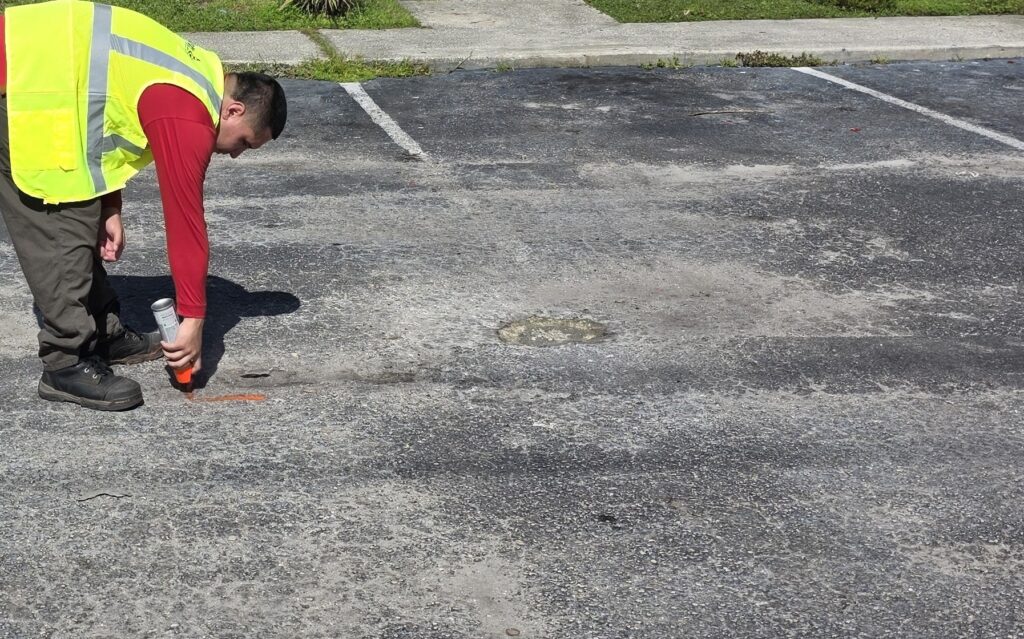
The call usually comes from the regional manager, not the carrier. “The insurance company is sending someone out to look at the property on Thursday.” The building team checks fire extinguisher tags and exit signs. Almost nobody walks the parking lot, and the parking lot is where the loss-control inspector is going to spend a surprising share of the visit, because it is where the slip, trip and fall claims and the vehicle damage claims on a commercial property actually come from.
This post is for the people who get that call: property and facility managers, HOA and condo boards, retail and portfolio operators, and the owners of office parks, hotels and apartment communities across Maryland, Virginia, Washington DC, Delaware, Pennsylvania, New Jersey and Florida. It covers what the inspection is, when it happens, what gets written up in the lot, what happens next, and how a dated repair record closes a finding. We repair potholes on these lots all year, and we have read enough inspection recommendations to know which ones land on the asphalt.
Key takeaways
- A loss-control inspection is the insurer’s own look at the property, separate from any municipal or fire inspection. It checks that the property matches how the policy was quoted and identifies conditions that could produce a claim.
- Parking lot and sidewalk condition sits in the liability section of the inspection alongside ADA compliance. The standard industry checklist asks directly whether there are potholes or other deterioration requiring repair, and whether puddles of water are present and repairs are planned.
- Potholes, failed patch edges and standing water get written up first because they are the easiest hazards for an inspector to see and photograph, and the easiest for a plaintiff’s attorney to photograph later.
- A written recommendation usually comes with a compliance window. The answer that closes it is a dated repair record with before and after photos, not a promise to get to it in the spring.
- Pothole and trip-hazard findings should be repaired right away, including in winter. Thermal asphalt repair works all year, most repairs take about 20 minutes, and the lot stays open while the work is done.
What Is an Insurance Loss-Control Inspection?
Direct answer: A loss-control inspection, also called a loss-control survey or risk survey, is a site visit by the insurer or its contractor to confirm the property matches the application and to identify conditions likely to cause a claim. The findings feed underwriting, premium and renewal decisions and often come back to the insured as written recommendations with a deadline.
Insurers call it loss control because the point of the visit is to lower the chance of a paid loss. The inspector is not a code official, although code violations get noted. The job is to confirm the facts the policy was priced on, such as construction type, square footage, roof and occupancy, and to identify the hazards most likely to turn into a claim against the property’s liability or package policy.
On a commercial property that puts the exterior in scope. One insurance agency white paper on commercial inspections lists the liability section as parking lot and sidewalk conditions, ADA compliance, safety protocols for public-facing areas, and slip, trip and fall prevention. In the inspector’s eyes a pothole is not a maintenance item. It is a claim that has not happened yet.
The inspector is also comparing what they see to what the policy was bound on. One specialty commercial carrier’s loss-control brochure says the survey confirms the property’s characteristics “align with how the policy was quoted and bound.” A lot described as well maintained on the application that shows a dozen open potholes on the visit is a credibility problem as much as a pavement problem.
When Does the Loss-Control Inspector Show Up?
Direct answer: Inspections happen when a policy is written, at renewal, after a significant claim, and on the carrier’s routine risk cycle. One specialty carrier tells new policyholders to expect the survey within 30 to 60 days of coverage taking effect. For a January renewal in the Mid-Atlantic, that puts the inspector on the lot in February, the worst month for asphalt.
Timing matters more than most managers realize. Commercial property policies renew on a calendar, and January 1 renewals are common. A survey scheduled 30 to 60 days after binding lands in the freeze and thaw window across Baltimore, Washington DC, Philadelphia, Northern New Jersey and Richmond, when a crack that was hairline in November has become a pothole and the patch from two winters ago has lifted at the seam.
In Florida the calendar runs the other way. A renewal survey in Orlando or Tampa in late summer arrives at the end of the wet season, when a lot that drains badly has held water in its low spots for months. Standing water is on the checklist by name, and it does not need a freeze to produce a pothole, only traffic.
The post-claim survey is the one nobody plans for. A slip and fall or vehicle damage claim on the lot can trigger a visit on its own, and that inspector has read the claim file and knows exactly where to walk first.
What Does the Inspector Look For in the Parking Lot?
Direct answer: The industry checklist covers pavement condition, including potholes, deterioration and standing water, plus trip hazards such as wheel stops, speed bumps and curbs, whether those hazards carry contrasting paint, lane and crosswalk markings, pedestrian walkways, lighting and security. Pavement defects are the items a property manager can clear fastest and the ones most often photographed in a claim.
The checklist most inspectors work from, or a carrier’s version of it, is short and specific. The standard parking lot liability checklist published by ISO Services and distributed by major commercial carriers asks, in its temporary hazards section, whether there are potholes or other deterioration requiring repair, whether there are puddles of water and if so whether there are plans to repair the lot, whether snow or ice is present, and whether oil, grease or other foreign material is on the surface. Its construction section asks whether trip hazards such as speed bumps and steps carry a contrasting paint color, whether wheel stops and berms are designed and marked to limit tripping, whether pedestrians have a safe walkway, and whether lighting is adequate.
Here is how those questions translate on a real lot and what closes each one.
| What the inspector checks | What gets written up | What closes the item |
|---|---|---|
| Potholes and deterioration | Open potholes, raveled areas breaking through, lifted or sunken patch edges, broken utility cuts | A permanent repair with a dated record and before and after photos |
| Puddles and standing water | Ponding in drive aisles, at catch basins and in the accessible route; the checklist asks whether repairs are planned | A repair that restores the surface where traffic has worn the low spot, or a drainage correction where the base has settled |
| Trip hazards on the walking path | Vertical lips at patch seams, heaved sections, broken curb at the ramp, unmarked wheel stops | A seamless repair at the pavement; contrasting paint or removal for the fixed hazards |
| Markings and walkways | Faded stripes, no crosswalk from the stalls to the entrance, markings that mean something different from the public road | A striping contractor. Not a pothole repair item, but repair the pavement before new paint goes down |
| Lighting and security | Dark corners, dead fixtures, no cameras on the lot | An electrician or security vendor; outside our trade |
The pothole and standing water rows are the ones a property manager can clear before the inspector’s report is typed, which is why they get the most attention. Lighting and striping are real findings for other trades.
Why Do Potholes and Standing Water Get Written Up First?
Direct answer: Because they are visible, measurable and photographable, and because they connect directly to the two claim types a commercial lot produces: pedestrian falls and vehicle damage. An inspector documents a pothole in thirty seconds, and the same photo is the first exhibit in a premises liability claim, so an open pothole reads as an unaddressed hazard, not a maintenance backlog.
An inspector has limited time on site and a report to write. A pothole in a drive aisle or a lifted patch edge on the path between the stalls and the entrance needs no interpretation. It is a hole in the path of travel, and the inspector’s photo of it looks the same as the one a claimant’s attorney would take.
Standing water gets the same treatment, and the checklist’s phrasing is telling: it asks whether puddles are present and, if so, whether there are plans to repair the lot. Water sitting on asphalt is water getting into asphalt, and in the Mid-Atlantic that water is going to freeze. A puddle in a February survey is a pothole by the renewal date.
The accessible route gets a closer look than the rest of the lot. The 2010 ADA Standards for Accessible Design allow a vertical change in level of no more than a quarter inch on an accessible route, require a change between a quarter inch and a half inch to be beveled, and require anything over a half inch to be ramped. A patch that has lifted three quarters of an inch at its seam in the accessible aisle is a finding on two lists at once: a trip hazard and an accessibility defect. We cover the walk-through for these conditions in our parking lot inspection checklist, and the seam problem itself in why asphalt patches fail at the seam.
What Happens After the Inspector Writes Up the Lot?
Direct answer: The findings go to the underwriter, who can accept the risk as written, issue recommendations with a compliance deadline, adjust the premium, or in serious cases decline or non-renew. A pavement recommendation asks for the hazard to be corrected within a set period, with proof. Ignoring it turns a maintenance note into a coverage problem.
The report itself usually arrives as a list of recommendations, each with a priority and a date. The agency white paper we cited describes the range of outcomes plainly: the policy may be approved as proposed, the insurer may recommend or require specific improvements, the premium may be adjusted to reflect the risk, and where significant hazards are found coverage may be denied or canceled. Pavement findings rarely reach the last outcome on their own, but they are counted alongside everything else the inspector saw.
What matters for the property manager is the reply. A recommendation that says “repair potholes in the north drive aisle” is closed by a repair record, not by an email saying the repair is scheduled for spring. Carriers track open recommendations into the next renewal, and an item written up twice is a different conversation with the underwriter than one written up once and closed in a week.
If a claim is already in the file, the stakes change again. The first two days after a claim have their own playbook, which we laid out in the property manager’s first 48 hours after a pothole damage claim. An inspection recommendation on the same hazard, still open, is the fact pattern a plaintiff’s attorney hopes to find.
How Does a Dated Repair Record Answer the Inspector?
Direct answer: A record showing the lot was inspected on a schedule, each defect marked and photographed, and each repair completed on a date with an after photo gives the inspector a closed item and the carrier evidence of a maintained property. It answers the checklist’s “are there plans to repair the lot” question with a plan that already ran.
Every inspection we do starts the way the photo on this post shows: a specialist walks the lot, marks every pothole, failed patch edge and broken seam in orange paint, photographs it, and builds an interactive inspection report the property manager reviews and approves by click. The report lists what we found, what we recommend repairing, and anything out of scope that needs another trade, such as a collapsed drain or a section of base failure.
Clients on the PARC Plan get that inspection three times a year, scheduled around the region’s asphalt stress seasons, with a comprehensive report after every visit. The plan page calls that documentation valuable for insurance, attorneys, owners and boards, and this is the situation it means. When the inspector asks what the maintenance program is, the answer is a dated series of inspection reports and repair records, not a description of one. We wrote about building that file in claims-defense asphalt maintenance records, and about how a portfolio measures it in the portfolio asphalt ROI playbook.
The repair method shows up in the record too. The inspector’s puddle question is really a seam question: traditional patching leaves a cold joint around every repair, water enters at the joint, and the patch edge becomes next year’s finding. Thermal asphalt repair heats the existing pavement in place and bonds the repair to the surrounding surface with no seam, which is why a repair from last winter is not on this winter’s list. A property manager who can show that the write-up from the last survey was repaired permanently, not refilled, is presenting a different risk than one who shows the same hazard patched every spring.
What Should a Property Manager Do Before the Inspection?
Direct answer: Walk the lot the way the inspector will, from the street entrance to the front door and through the accessible route, marking every pothole, lifted seam, puddle and broken curb. Repair the pavement defects before the visit, pull the maintenance and repair records into one file, and write down a dated plan for anything that cannot be fixed in time.
The agency white paper’s advice for the building applies to the lot: start with a self-assessment, review maintenance logs and repair records, and address previously cited hazards before the visit. For the parking lot that means three things.
First, walk it with the checklist’s eyes. Drive aisles, the stalls nearest the entrance, the accessible aisle and ramp, the dumpster pad approach, the catch basins and the loading area are where defects concentrate. Mark everything, including the patch edges that look fine from the car and feel like a step underfoot.
Second, repair what you marked, and do not let the calendar talk you out of it. A loss-control survey in January or February across Baltimore, Washington DC, the Philadelphia metro, Northern New Jersey, Delaware or Richmond does not come with a winter exemption, and neither does the claim that follows an open pothole. Thermal repair works all winter, most repairs take about 20 minutes, and the lot stays open while the crew works. A commercial parking lot pothole repair completed the week before the visit, with the record in hand, is the best possible answer to the first row on the checklist. In Orlando and Tampa the same applies to the low spots that held water through the wet season.
Third, put the file together: inspection reports, repair invoices, before and after photos, striping and lighting work orders, the snow contractor’s log in the Mid-Atlantic, one folder in date order. An inspector handed that folder at the start of the visit walks the lot differently than one told the records are “with the vendor.”
What Can a Pothole Repair Not Fix on the Inspector’s List?
Direct answer: Lighting, cameras, striping, wheel stop design and a ramp built to the wrong slope are findings for other trades. So is base failure: a section that has alligatored across its full width has lost its foundation, and the honest recommendation is reconstruction by a paving contractor, which we do not do. Every pothole and failed seam in between, we repair.
Scope matters, because an inspector’s report mixes trades on one page. We repair and save existing asphalt. We are not a paving company and we do not resurface or rebuild lots. When our inspection finds a section where the base has failed, the report says so and flags it as out of scope, and that note is itself useful to the property manager, because it separates the handful of areas that need capital planning from the long list of isolated defects that can be closed this month. For the decision between the two, see when repair beats repaving a commercial lot.
The rest of the list, from lighting to crosswalk paint, belongs to vendors you probably already use. The practical sequence is pavement first. Fresh stripes over a lifting patch edge last one season, and a new light fixture does not change what the inspector photographs underneath it.
What a recommendation means for your specific policy, and how to respond to it in writing, is a question for your broker and carrier. What we can give you is the thing they will ask for: a lot with no open pavement hazards and a record that proves it.
Frequently Asked Questions
What does a loss-control inspector do?
A loss-control inspector visits an insured property on behalf of the carrier to confirm it matches the application and to identify conditions likely to produce a claim. On a commercial property that includes the building systems, the occupancy and the exterior, where parking lot and sidewalk condition, ADA compliance and slip, trip and fall hazards are assessed. The findings go to the underwriter and usually come back as written recommendations with a deadline.
What is a parking lot audit for insurance purposes?
A documented walk of the lot against a liability checklist: potholes and deterioration, standing water, snow and ice, oil and debris, trip hazards such as wheel stops and speed bumps and whether they carry contrasting paint, lane and crosswalk markings, pedestrian walkways, lighting and security. Property managers who run that audit on a schedule and keep the reports are answering the inspector’s questions before they are asked.
Can a parking lot finding affect the premium or the renewal?
It can. Inspection findings feed underwriting, and the outcomes described by insurers range from approving the policy as written, to recommendations with a compliance window, to a premium adjustment, to declining or non-renewing where significant hazards are found. A pavement recommendation that stays open across two surveys weighs more than one that was closed with a dated repair record. Your broker can tell you how your carrier handles open recommendations.
Should we repair the potholes before the inspection or wait until spring?
No. Damage should be addressed immediately. An open pothole is a hazard whether or not an inspector has seen it, every freeze and thaw cycle makes it larger, and a recommendation that is still open at renewal is the worst version of the finding. Thermal asphalt repair works all winter, most repairs take about 20 minutes, and the lot stays open during the work.
Does the inspector care how the pothole was repaired?
The inspector cares whether the hazard is gone and whether it stays gone. A repair that lifts at its seam by the next survey becomes a repeat finding, and a repeat finding reads as deferred maintenance. A seamless thermal repair, documented with a date and an after photo, closes the item and does not reappear, which is the result the carrier is looking for.
Is the lot ready for the inspector?
Find out before the carrier does. Our specialists walk the lot, mark every pothole, failed patch edge and broken seam, and send you a documented inspection report with the repairs scheduled around your operations. We repair all winter across the Mid-Atlantic and Florida, and the inspection is free.
Sources: ISO Services, Inc., Parking Lot Inspection: Liability, checklist CH-40-40 (2014), as distributed by a major commercial carrier’s risk engineering practice: temporary hazards (snow or ice; puddles of water and whether there are plans to repair the lot; oil, grease or other foreign substance; potholes or other deterioration requiring repair or repaving) and construction items (contrasting paint on trip hazards, wheel stops and berms marked to limit tripping, safe pedestrian walkway, adequate lighting). A specialty commercial property carrier’s policyholder brochure, Commercial Loss Control: What to expect from your loss control survey (survey within 30 to 60 days of coverage going into effect; the representative confirms characteristics align with how the policy was quoted and bound). Professional Insurors, What to Expect from a Commercial Property Insurance Inspection, white paper, May 2025 (inspections at new policy, renewal, after a major loss and on routine cycles; liability exposures include parking lot and sidewalk conditions and ADA compliance; outcomes range from approval to recommendations, premium adjustment, denial or cancellation; prepare with maintenance logs and repair records). US Department of Justice, 2010 ADA Standards for Accessible Design, sections 303.2, 303.3 and 303.4 (changes in level: vertical to one quarter inch, beveled between one quarter and one half inch, ramped above one half inch).
