
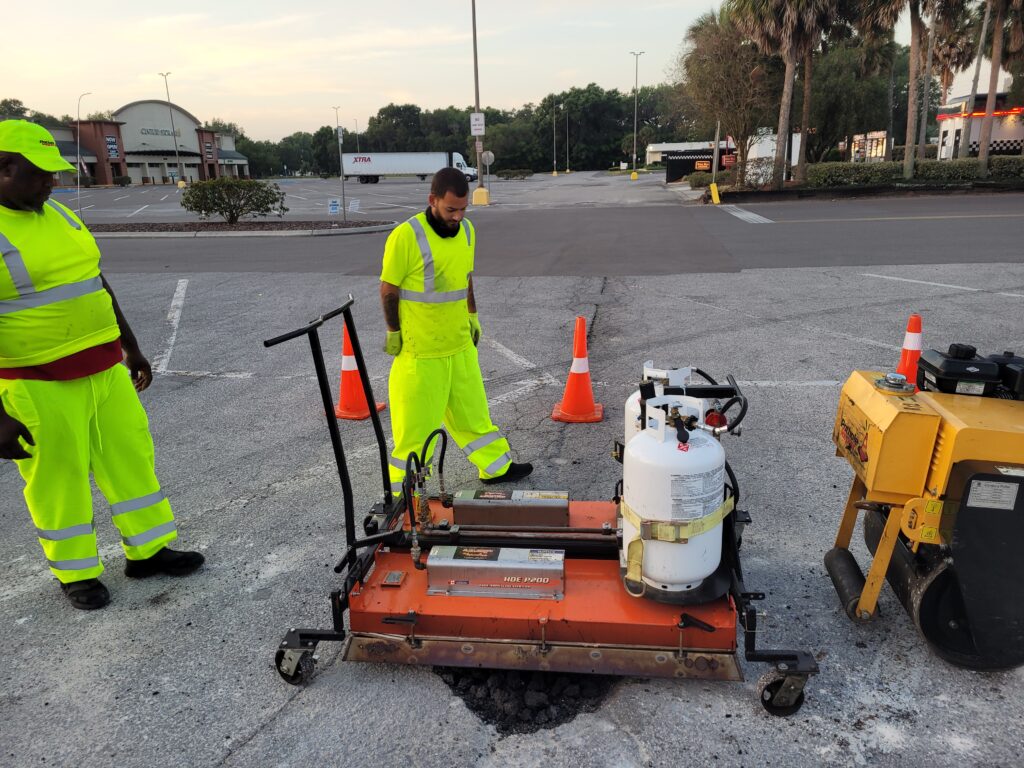
Most parking lots do not fail all at once. They fail one wheel path, one drain apron, and one loading dock corner at a time, and the property manager finds out when a tenant calls about a wheel or a shopper trips at the entrance. Trigger-based maintenance replaces that pattern with a short list of conditions that automatically start a repair, no debate and no waiting for the next budget cycle.
Our crews have been repairing commercial asphalt across the Mid-Atlantic and Florida since 2010, and the sites that stay out of trouble all run some version of the same system: a written parking lot inspection checklist, a set of thresholds tied to it, and a repair vendor who can act inside a few days. This guide lays out the thresholds we use ourselves, so you can put them in your own program before the next freeze-thaw cycle or storm season does the deciding for you.
Key takeaways
- A repair trigger is a written pavement condition that starts a work order on its own, so the response no longer depends on who noticed the damage or how busy the week is.
- Any pothole, soft spot, or failed patch in a drive lane, an entrance, an accessible route, or near a building door is an immediate repair trigger, regardless of size.
- Connected cracking, exposed base at a broken edge, and water that stands after the rest of the lot has dried are the three early triggers that predict potholes weeks before they open.
- Season and traffic tighten the thresholds: Mid-Atlantic lots need a post-thaw inspection every winter, Florida lots need one after storm season, and truck traffic cuts the acceptable defect size in half.
- Potholes should be repaired before any surface work by a paving vendor, and always before the claim, not after it.
What is trigger-based pothole repair?
Direct answer: Trigger-based pothole repair is a maintenance rule set where specific, measurable pavement conditions automatically start a repair work order. Instead of fixing potholes when someone complains or when the annual budget opens, the property team inspects on a schedule, compares what it finds against written thresholds, and dispatches the repair the moment a threshold is crossed.
The difference between a reactive lot and a managed lot is usually not money. It is the absence of a rule. Without one, a pothole sits until it gets big enough that someone feels responsible for it, and by then the base underneath is wet, the edges have spread, and the repair is three times the size it needed to be. A trigger does the deciding for you: write down the condition, write down the response, and inspect often enough to catch it.
These thresholds are about commercial asphalt repair, the targeted work that keeps an existing lot in service. If your inspection shows failures across most of the surface, the honest answer may be a paving project, and we will say so rather than patch something that will not hold.
How do you inspect a commercial lot for repair triggers?
Direct answer: Walk the lot in daylight on a set route: entrances first, then drive aisles, loading zones, accessible routes, and finally the parking stalls. Photograph every defect with something for scale, mark it on a site map, and note whether it sits in a wheel path or a pedestrian path. That record is what turns a walk into a repair schedule.
A pavement inspection is a walk, not a drive-through. From a car you see color and striping. On foot you feel the soft spots, hear loose aggregate under your shoe, and see the water line left in a low spot after yesterday’s rain. Start at the entrances and drive aisles, where a defect meets the most tires and the most feet.
Keep the checklist short enough that it actually gets used:
- Entrances and exits: any hole, heave, or broken apron that jolts a vehicle
- Drive aisles and wheel paths: connected cracking, depressions, soft spots that flex under a boot
- Loading docks and dumpster pads: crushed edges, pushed asphalt, potholes at the trailer wheel line
- Accessible routes and building approaches: any lip, hole, or loose material on a path a person walks
- Drains, inlets, and curb lines: broken edges and standing water
Photograph each item with a boot, a tape, or a cone in frame for scale, and pin it to a site map. Date everything. The same photo set that drives the repair schedule is the record you will want if a claim ever comes in, which is why we covered the documentation side separately in our guide to claims-defense asphalt maintenance records.
Which crack patterns mean a pothole is coming?
Direct answer: Connected cracking is the trigger. A single straight crack is a watch item, but block cracking, alligator cracking, or any crack pattern that has started to loosen pieces means water is already reaching the base and a pothole is forming underneath. Treat connected cracking in a wheel path as a repair, not a monitoring item.
Not every crack is a problem. A long transverse crack across a low-use stall can sit for a season. The cracks that matter are the ones that connect, because each connection is another route for water to the base, and a wet base is the thing that actually makes a pothole. Once the pieces between the cracks start to rock under a tire, the surface is done holding itself together.
Our repair triggers for cracking on a commercial lot:
- Alligator or fatigue cracking anywhere in a drive aisle, entrance, or loading zone
- Block cracking where the blocks have begun to separate or tilt
- Any crack pattern with loose or missing pieces, regardless of location
- Cracks that already hold water or show mud pumping up through them after rain
This is where a lot of maintenance programs go wrong. The instinct is to treat cracks as a surface problem. Once the surface over a wet base has started to break into pieces, the right repair is to rebuild the failed area, which is what infrared asphalt repair does: we heat the failed section, rework the existing asphalt with fresh mix, and compact it into a seamless repair. Our article on why asphalt patches fail at the seam explains why a thrown-in patch does not.
What do raveling, edge breakup, and ponding tell you?
Direct answer: Raveling, edge breakup, and ponding are the three early triggers that predict potholes weeks ahead. Raveling means the surface is losing its binder and shedding stone. Edge breakup means water has a direct path to the base. Ponding means the base has already settled. Each one is a repair trigger before a hole ever opens.
Raveling shows up as a rough, sandy texture with loose grit collecting at the low end of the slope. Early on it is a watch item. It becomes a trigger when you can see stone pulled out across a lane rather than in a few spots, or when tires start to sound different crossing it. At that stage the surface is too loose to hold up.
Edge breakup is the one property managers underrate. When the outer edge of an aisle or a parking bay crumbles, it exposes base stone or soil, and every rain event from then on runs water straight under the pavement. Snowplows and delivery trucks catch the broken edge and pull more of it away. Our trigger is simple: exposed base at any edge means a repair, and a broken edge near a drain or an inlet moves to the top of the list.
Ponding is the base talking. If a spot holds water after the rest of the lot has dried, the material underneath has settled, and the asphalt over it is flexing every time a vehicle crosses. The birdbath in the wheel path at the entrance is where the next pothole opens, usually right after the first hard freeze in Maryland and Virginia, or after a week of afternoon storms in Orlando. We level those areas by rebuilding the depression with hot mix, not by coating over them. Our emergency versus planned repair triage framework covers how to rank drainage defects against safety defects when both show up on the same walk.
When does a pothole need repair right away?
Direct answer: Immediately, if it sits in a drive lane, an entrance, an accessible route, or within a few steps of a building door. Location beats size. Outside those zones, a hole wider than a dinner plate or deeper than an inch is a repair trigger, and so is a cluster of smaller holes or a patch that has failed once already.
Size is the wrong first question. A shallow hole at the front entrance of a grocery-anchored center will produce a claim faster than a deep one in the back row that nobody drives through. So our first filter is where the pothole is, and the second is what it is doing.
Immediate repair triggers on a commercial lot:
- Any pothole in an entrance, exit, drive aisle, or fire lane
- Any pothole on an accessible route, at a crosswalk, or near a building door
- Clusters of holes or soft spots forming in the same area, which means the base is failing under all of them
- A pothole that has reopened after an earlier patch
- Any hole at a loading dock or dumpster pad where trucks turn
The reopened pothole deserves its own line because it tells you something. A hole that comes back after a cold patch or a quick throw-and-go fix was never repaired, it was covered. The second time, the base is wetter and the failed area is larger. This is the case for a permanent repair on the first call, and it is why our commercial parking lot pothole repair is built around thermal and hot patch methods that bond to the existing asphalt instead of sitting in it. The math on doing it once versus repeatedly is in our 12-month versus 5-year case study.
How do season and traffic change the thresholds?
Direct answer: Season decides when you inspect and traffic decides how tight the thresholds are. Mid-Atlantic lots need a full inspection after the last freeze-thaw cycle, Florida lots need one after storm season, and any site with regular truck traffic should treat defects at roughly half the size a light-duty office lot can tolerate.
In Maryland, Virginia, Pennsylvania, and New Jersey the calendar is set by freeze-thaw. Water gets into the cracks in December, freezes and expands in January, and the surface heaves and breaks loose on the first warm week, and plows finish the job. That is why we tell property teams around Washington DC and Baltimore to schedule the key inspection for late February or March, before the thaw damage has a full spring of traffic on it, with a second walk in October before the ground freezes.
Florida flips the problem. There is no freeze, but there is standing water almost daily from June through September, plus heat that softens the binder and truck loads that push it. Lots around Orlando and Tampa tend to fail at the drains and the delivery lanes rather than across the whole surface, so the storm-season inspection should concentrate there.
Traffic sets the second dial. A low-use office lot can carry a minor defect for a season if it is not on a walking route. A grocery center, a medical campus, or a distribution site cannot. For sites with regular truck traffic we cut every size threshold in half: a hole that would be a scheduled repair on an office lot is an immediate repair at a dock. Retail owners can see how this plays out on our shopping and retail asphalt repair page.
How do you turn the inspection into a repair schedule?
Direct answer: Group the findings into three buckets: immediate (safety, accessible routes, active potholes in traffic), scheduled (early triggers such as connected cracking, edge breakup, and ponding), and monitor (isolated cosmetic defects). Dispatch the first bucket within days, batch the second into one planned visit, and re-check the third on the next walk.
The inspection is only useful if it ends in dates. Immediate items get a work order the same week. Scheduled items get batched into one planned visit so the crew mobilizes once instead of four times, which is also how you avoid closing a section of the lot more than once. Monitor items go back on the checklist with a photo, and if they are worse on the next walk they move up.
Write the thresholds into the scope you give your vendor, so both sides know what starts a repair and what the finished work should look like. Our guide on what belongs in a commercial asphalt repair scope of work has the line items. For multi-site owners, the same thresholds applied everywhere are what make a portfolio asphalt maintenance plan work, because a site manager in Leesburg and one in Orlando are reading from the same rules. If you would rather not run the inspections yourself, that is what the PARC Plan is for: scheduled inspections against these same triggers, priority scheduling when a threshold is crossed, and one documented history per site.
One more timing rule. If a paving vendor is coming to sealcoat or restripe the lot, get every pothole, failed patch, and broken edge repaired first. Surface work over an unstable base fails early and hides the problem until it is bigger. We do the repairs, the coating vendor does the coating, and the order matters.
Frequently asked questions about pothole repair thresholds
How often should a commercial parking lot be inspected for potholes?
Walk the whole lot at least quarterly, and add a pass after every freeze-thaw stretch in the Mid-Atlantic or after the summer storm season in Florida. High-traffic retail, medical, and logistics sites usually need a monthly look at entrances and drive aisles, because those are the areas that fail first.
What size pothole needs to be repaired right away?
Any pothole in a drive lane, an entrance, an accessible route, or near a building door should be repaired as soon as you find it, whatever its size. Outside those zones, treat anything wider than a dinner plate or deeper than an inch as a repair trigger, and treat clusters of smaller holes the same way.
Should potholes be repaired before a lot is sealcoated?
Yes. A surface coating applied by a paving vendor does nothing for a pothole or a soft base underneath it. Get every pothole, failed patch, and broken edge repaired first, then let your paving vendor handle any coating on top of a stable lot. We handle the repairs, not the coating.
Can trigger-based pothole repair work across a multi-site portfolio?
It works best there. One written set of thresholds gives every site manager the same rules, so a pothole in Baltimore gets the same response as one in Orlando. Pair the thresholds with a scheduled inspection program like our PARC Plan and the repair calls stop depending on who happened to notice the hole.
Is PotholeRepair.com a paving company?
No. We repair and save existing asphalt with infrared thermal repair, hot patch, and cold fill. We do not repave, resurface, or sealcoat lots. When a section is beyond repair, we will tell you plainly so you can budget for a paving contractor instead of paying us to patch something that will not hold.
Get Your Free Inspection
If your last walk turned up connected cracking, a broken edge, or a pothole anywhere near an entrance, the threshold has already been crossed. We will inspect the lot, mark every trigger on a site map, and give you a repair plan you can put straight into the schedule. Request your free inspection and we will get a crew to your site with the right method for each repair, without shutting your property down.
