
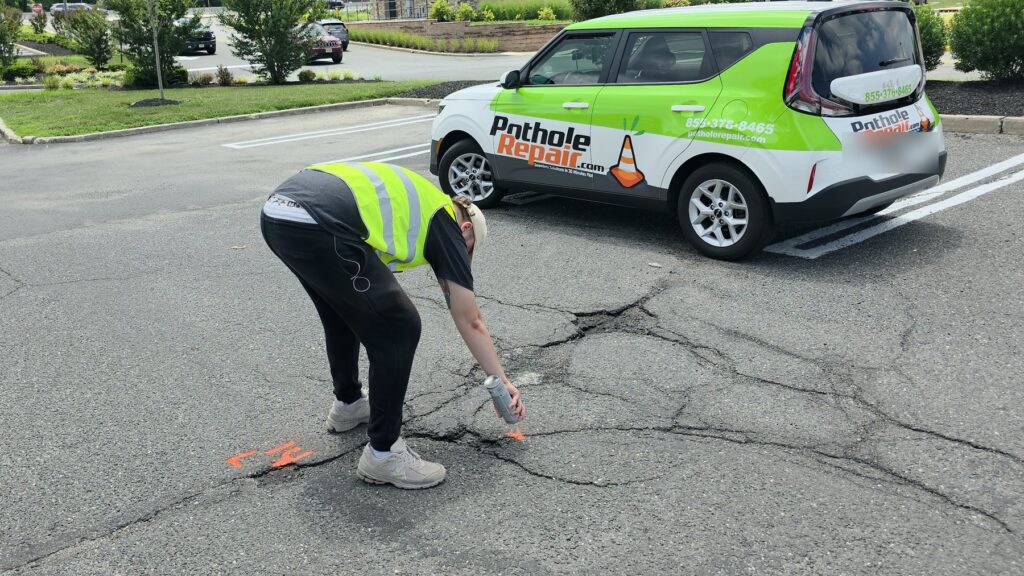
A pothole damage claim usually arrives the same way: a driver calls the leasing office or the tenant’s store manager, says a hole in your parking lot bent a rim or blew a tire, and wants to know who is going to pay. Sometimes it comes as an email with photos attached, sometimes as a letter from an insurer a week later. Either way, the first 48 hours decide how much that claim costs, and almost none of that cost is the repair itself.
This is the property manager’s version of the answer, not the driver’s. It covers who needs to hear about the claim first, what to document before anyone touches the pothole, whether to repair now or wait, what the adjuster is going to ask for, and how a dated repair record closes the file. It applies to retail centers, office parks, HOA and condo lots, hotels and campuses across the Mid-Atlantic and Florida. It is general guidance from the repair side of the business, not legal advice; your carrier and your attorney have the final word on any specific claim.
Key takeaways
- Notify your insurance carrier or broker the day the claim comes in. Most commercial general liability policies require notice of an occurrence as soon as practicable, and a late report is a problem you create for yourself.
- Document the pothole before it is repaired: dated photos with a scale object, length, width and depth, its exact location in the lot, the weather and lighting, and the driver’s own account in writing. Then preserve any camera footage covering that spot.
- Do not leave a known hazard open while you wait. Document it fully, tell the adjuster when you report the claim that you intend to repair, and fix it. A second claim from the same hole is far more expensive than the first.
- The question that decides most claims is not whether the pothole existed. It is how long you knew about it and what you did. Dated inspection reports and work orders answer that question; memory does not.
- One pothole claim is a signal about the whole lot. Walk every row within the week, check the accessible route, and move the property onto a scheduled inspection cadence so the next hazard is found by your inspector, not by a driver.
What Happens in the First 48 Hours After a Pothole Damage Claim?
Direct answer: In order: take the driver’s details and a written account, notify your carrier and the ownership, document the pothole with dated measured photos, preserve camera footage, confirm with the adjuster that you will repair, and get the hole fixed and photographed again. Done in that sequence, the claim becomes a file with a beginning, a middle and an end.
The order matters more than the speed. A manager who repairs first and photographs later has a hole in the record exactly where the adjuster will look. A manager who photographs, notifies and then leaves the pothole open for ten days while waiting for someone to inspect it has a known hazard on the property with a claim already attached to it. The sequence above keeps both problems off the file.
Day one is intake, notice and documentation. Day two is the repair decision and, in most cases, the repair itself. A permanent thermal repair takes about 20 minutes per pothole and the lot stays open while it happens, so there is rarely a scheduling reason to wait once the record is complete.
Who Needs to Know About a Pothole Damage Claim, and in What Order?
Direct answer: Your insurance carrier or broker first, the owner or asset manager second, then the tenant whose customer was involved and the vendor who will repair the hole. Do not admit fault, do not promise payment, and do not argue with the driver. Collect their name, contact details, vehicle, the date and time, and where in the lot it happened.
The carrier comes first because the policy says so. Commercial general liability policies carry a notice condition, usually worded as notice of an occurrence “as soon as practicable,” and insurers do deny or contest claims where the insured sat on the report. Whether a particular claim is covered, or falls under a deductible, is the adjuster’s decision, not yours.
The owner or asset manager hears about it that day for a different reason. A pothole claim is an incident on the property, and the person who signs the maintenance budget needs to know the lot has reached the point where it is generating claims. That conversation is also where a scheduled repair program gets approved, which is why it should not wait for the claim to resolve.
The tenant matters because the driver was usually their customer, and the lease may say who maintains the parking areas. On a shopping center, the store manager who took the first call is also your best witness to what the driver said at the time. Ask them to write it down while it is fresh.
What you say to the driver is the part managers get wrong. Be courteous, take the information, tell them the matter has been referred to the property’s insurer, and stop there. “We’ll take care of it” sounds kind and reads later as an admission. “The insurer will be in touch” is the sentence to use.
What Should You Document Before Anyone Touches the Pothole?
Direct answer: Dated photographs of the pothole from several angles with a tape measure for scale, its length, width and depth, a wide shot showing its position in the lot, the weather and lighting, the driver’s written account, and any camera footage. Pull the last inspection report and every work order for that area into the same folder.
Photographs are the record the adjuster reads first. Take your own, the day the claim arrives, in daylight if the incident happened at night and again at night if lighting is part of the story. Get close enough to see the broken edge and the depth, then step back far enough to show which row and which space.
Measure it. Depth is the number people skip and the one that matters: a shallow surface spall and a hole deep enough to damage a wheel are two very different claims. Measure from the surrounding pavement surface to the bottom of the hole, not from the lip.
Then preserve what you cannot recreate. Camera systems overwrite on a cycle, often within a couple of weeks, and once you have notice of a claim the footage covering that spot needs to be pulled and kept. Losing it after you knew a claim existed is a problem with a name, spoliation, and it is one your attorney would rather not explain.
Finally, gather the paper that already exists: the most recent pavement inspection report, the work orders for that section of the lot, any prior complaints about that spot, and the snow or storm log if the season applies. If the property is on a scheduled inspection program, this is the moment the dated reports earn their keep. If it is not, this is usually the moment a manager discovers there is no record at all, which is the subject of our earlier post on claims defense asphalt maintenance records.
Should You Repair the Pothole Now or Wait for the Adjuster?
Direct answer: Repair it as soon as the documentation is complete, and tell the adjuster that is your plan when you report the claim. Insurers do not want a known hazard left open on an insured property, and a second vehicle or a pedestrian hurt in the same hole turns one claim into a pattern. Document, notify, then fix.
This is the trade-off managers worry about most, and it is a real one. Repairing the hole removes the evidence; leaving it open keeps a hazard you now know about on the property. The way out is the sequence. Once the pothole is measured and photographed from every angle and the footage is saved, the evidence exists whether or not the asphalt does.
Say so to the adjuster when you make the report. “We have documented it and intend to repair it this week” is a sentence adjusters hear with relief. If a carrier wants its own inspector to see the hole first, they will say so, and that inspection is usually a matter of a day or two. Ask the question; do not assume the answer.
In the meantime, cone it. A cone or a barricade over the pothole, photographed in place, shows that the property responded the day it knew. On a busy retail lot that cone also keeps the next driver out of the hole until the crew arrives.
Which repair tier to use depends on the location and the season, not on the claim. A permanent thermal repair bonds the new material to the existing lot with no seam, which is what stops the same spot from reopening; it is the right call on the drive aisles, the entrance apron and anywhere near the accessible stalls. A temporary cold fill has a place as a stopgap in the dead of winter when a crew cannot get to the site, but a cold fill that pops out in the spring puts the same hazard back on the same square of asphalt, with a claim already on file for it. The decision rules are the same ones in our guide to parking lot pothole repair for commercial properties, and the service-life question is answered in how long an infrared asphalt repair lasts.
What Will the Adjuster Ask For?
Direct answer: How long the pothole existed, when the property first knew about it, what inspections were done and when, what repairs were made and by whom, and whether anyone had complained before. In other words, notice and response. Dated inspection reports, work orders and photos answer those questions; a verbal “we check the lot regularly” does not.
Premises liability turns on a simple idea: a property owner has a duty to keep the lot reasonably safe for the people invited onto it, and the owner is responsible for hazards it knew about or should have known about. That second phrase, should have known, is where a parking lot claim is won or lost. A pothole that opened in last night’s storm is a very different fact from a pothole that three months of inspection reports should have caught.
The properties that come through this well are not the ones with the best asphalt. They are the ones with a dated record. A scheduled inspection with photos and a written report, three times a year, is exactly the paper trail an adjuster or an attorney asks for, and it is the reason our PARC Plan inspections produce a documented report every visit rather than a verbal walk-through. That record is also what separates a one-time claim from a pattern; the earlier piece on liability risks in small asphalt repair decisions explains why a temporary patch on a known hazard is the worst answer to that question.
| Adjuster’s question | The document that answers it |
|---|---|
| How long was the pothole there? | The last inspection report with photos and its date; the storm or freeze log if the season applies |
| When did the property know? | The incident report, prior complaint log, the inspection report line item if it was listed |
| What did the property do? | The cone or barricade photo, the work order, the repair invoice with the date and method |
| Is there a maintenance program? | The inspection schedule, the previous reports, the repair history for the lot |
| Was it reasonable care? | All of the above, read together, with dates that line up |
What Does One Pothole Damage Claim Tell You About the Rest of the Lot?
Direct answer: That the lot has reached the point where water is under the surface and traffic is finding the weak spots. A pothole rarely forms alone. Walk every row within the week, pay attention to the accessible route, mark every failure point, and put the property on a scheduled inspection cadence before the next claim finds the next hole.
In the Mid-Atlantic the mechanism is freeze and thaw: water gets into a crack, freezes, lifts the surface, and traffic breaks the loosened piece out. That is why claims cluster from January through early spring on lots in Baltimore, Washington, DC and the Philadelphia metro, and why a lot that produced one claim in February usually has three more holes opening in March. In Florida there is no freeze; the wet season does the work instead. Afternoon storms from late spring through October saturate a sandy base, and the first potholes show up on the drive aisles and the dumpster approaches in lots around Orlando and across the state. The season differs; the lesson is the same.
When you walk the lot, start where the claim came from and work outward. Then check the places the eye skips: the entrance apron where every tire turns, the drop-off and delivery lanes, the accessible stalls and the route from them to the door, the row along the dumpster pad, and the edge where the asphalt meets a curb or a landscape bed. Mark each failure point and photograph it the same way you photographed the first.
The accessible route deserves its own look. The 2010 ADA Standards allow a vertical change of only a quarter inch on an accessible route, with changes up to half an inch beveled and anything greater ramped. A pothole or a heaved edge on that path is a different kind of exposure than a bent rim, and it is one a plaintiff’s attorney looks for first after a trip and fall. Fix those spots before the rest.
A property that has produced a claim should be on a scheduled inspection program with a written report each time, so that the question “when did you last check” always has a dated answer. That is the structural fix. The pothole was the symptom.
When Is Repairing the Pothole Not Enough?
Direct answer: When the claim involves an injury rather than a vehicle, when the same area has been patched before, or when the lot shows widespread alligator cracking and standing water rather than isolated holes. The first needs your attorney from day one. The last two mean the base or the drainage has failed, a reconstruction question, not a repair.
Vehicle damage claims and injury claims are handled by the same first 48 hours, but an injury changes who is in the room. If a driver or a pedestrian says they were hurt, notify counsel along with the carrier, keep your written contact with the claimant to the minimum, and let the insurer run the conversation. The documentation steps are identical; the stakes are not.
The second case is the lot that keeps coming back. If the work orders show the same square of asphalt patched twice in two years, the next adjuster is going to read that as a known recurring hazard, and a third patch does not help you. The honest answer is to find out why it keeps failing. Sometimes it is the seam of a conventional patch letting water back in, which a seamless thermal repair solves; the mechanics are in our piece on why asphalt patches fail at the seam. Sometimes it is water pooling in a low spot because the grade is wrong, and no surface repair fixes a drainage problem.
The third case is the one we tell clients plainly: we repair and save existing asphalt, we do not repave. A lot with interconnected alligator cracking across whole rows, soft spots that move under a truck, or water that stands for a day after rain has a base problem, and the inspection report should say so. We mark those areas as out of scope, repair the isolated failures that can be saved, and leave the reconstruction to a paving contractor. A claim file that shows you were told the truth about the lot, and acted on it, is worth more than one that shows another patch.
Frequently Asked Questions
Can a driver claim for pothole damage on a private parking lot?
They can file a claim, and many do, often starting with the store or office where they parked. Whether the property is responsible usually turns on whether the owner knew or should have known about the pothole and whether it responded reasonably. That is a question for your insurer and attorney, not the leasing office. Take the details, refer the driver to the insurer, and start the documentation that day.
Should I offer to pay for the driver’s tire or rim to make the claim go away?
Not on your own. A payment or a promise made at the counter can be read as an admission and can conflict with your policy’s conditions about settling claims without the carrier. Report it and let the adjuster decide how to resolve it. Being courteous and taking the matter seriously is not the same as accepting responsibility.
Does repairing the pothole right away hurt the claim?
Not if the pothole was documented first. Measured, dated photographs and preserved camera footage are the evidence; the hole itself is not. Tell the adjuster you intend to repair when you report the claim, cone the spot in the meantime, and fix it. Leaving a known hazard open on the lot is the greater risk.
What should a parking lot pothole incident report include?
The date and time of the incident and of the report, the driver’s name and contact details, the vehicle, the exact location in the lot, the driver’s account in their own words, the name of the staff member who took it, the weather and lighting, dated photographs with measurements, what was done right away (cone, barricade, notice to the carrier), and the repair date and method once the work is done.
How long does the repair take, and does the lot have to close?
A permanent thermal repair takes about 20 minutes per pothole, and the crew cones off only the spaces it is working in, so the lot stays open. The repair bonds to the surrounding asphalt with no seam, which is what keeps the same spot from reopening and producing a second claim.
Close the claim with a dated record, then stop the next one
An Asphalt Solutions Specialist walks the lot, marks and photographs every failure point, and sends you an interactive inspection report where each repair can be approved with a click. That report is the document a pothole damage claim asks for, and the repairs that follow take about 20 minutes each with the lot open. No cost, no obligation. Request your free inspection or read about our thermal pothole repair method for commercial lots across the Mid-Atlantic and Florida.
