
Every fall the same call comes into our office from property managers across Maryland, Virginia, Pennsylvania, Delaware and New Jersey: a pothole opened in the lot this week, the paving contractor says it is too cold to patch it, so is it? The short answer is that it depends entirely on the method. Conventional hot mix really does have a floor and a season. Thermal asphalt repair does not, because the heat comes with the crew instead of from a plant that closed for the winter.
This guide gives you the actual numbers behind the hot-mix cutoff, taken from a state highway specification rather than a sales pitch, explains why a thin patch is the first thing to fail when the air turns cold, and shows what a facility manager, HOA board or portfolio operator should do with a pothole that opens in November. It is written for commercial lots in the Mid-Atlantic and Florida, where the cutoff looks different, and it comes from the side of the business that repairs potholes all winter.
Key takeaways
- Hot-mix asphalt has a published season and a temperature floor. PennDOT’s Publication 408 allows paving mixtures from April 1 to October 31 and prohibits placement when the air or surface temperature is 40 degrees Fahrenheit or lower, with a 50 degree floor for the more sensitive mixes.
- A pothole patch is the thinnest, smallest piece of hot mix a crew will ever place, so it cools out of its compaction window fastest. In cold air a conventional patch can be too cool to compact before the crew finishes raking it, and an under-compacted patch fails at its seam.
- Thermal asphalt repair heats the existing pavement in place, reworks it with the surrounding surface and compacts it as one piece. It does not depend on plant mix or a plant calendar, so it works in January the same way it works in June. Most repairs take about 20 minutes and the lot stays open.
- Should a pothole that opens in November wait until spring? No. Damage should be addressed immediately. Every freeze and thaw cycle widens it, plow blades catch its edge, and an open hole you knew about is the center of any damage claim.
- Florida has no hard freeze and no plant shutdown, so its cutoff is water, not cold: wet surfaces and afternoon rain stop any repair. In both regions the right move in cold or wet weather is to repair the hole the week it appears with a method that is built for the conditions.
How Cold Is Too Cold to Repair a Parking Lot With Hot Mix?
Direct answer: For conventional hot-mix asphalt the cutoff is roughly 40 degrees Fahrenheit at the air and at the pavement surface, on a dry surface, and only while the plants run. PennDOT’s specification sets the season at April 1 to October 31 and bars placement at 40 degrees or lower; thin wearing courses and specialty mixes stop at 50 degrees.
The number most property managers have heard, 40 degrees, is real and it is written down. PennDOT Publication 408, the construction specification Pennsylvania uses for its own roads, states in Section 413 that asphalt paving mixtures may be placed from April 1 to October 31, that thin wearing courses under 1.5 inches close on October 15, and that no mixture is placed when surfaces are wet or when the air or surface temperature is 40 degrees Fahrenheit or lower. Stone matrix and other sensitive mixes carry a 50 degree floor and shut down on October 1 in the colder districts. Maryland, Delaware, New Jersey and Virginia write their own versions, and they land in the same neighborhood for the same physical reasons.
Those rules were written for highways, but the material in your parking lot is the same material, and a repair crew placing a patch out of a hot box in your drive aisle is bound by the same chemistry whether or not a state inspector is standing there. The practical cutoff for a conventional patch is usually earlier than the printed one, because the spec assumes a full paving train laying a thick lift. A patch is neither.
The other half of the cutoff is supply. Hot mix comes from a plant, and asphalt plants close over the winter months in the Mid-Atlantic. Once the plant nearest your property stops producing, a conventional repair contractor has nothing to put in the hole no matter what the thermometer says. That is the real reason “we will be back in the spring” is the standard answer from November through March, and it is a supply answer, not a safety answer.
Why Does Hot Mix Stop Working When the Temperature Drops?
Direct answer: Hot mix can only be compacted while it is hot, roughly between 275 and 175 degrees Fahrenheit. Cold air, wind and a cold base pull heat out fast, and a thin pothole patch loses it fastest. Below the window, rolling no longer densifies it, water gets in at the seam, and the patch pops out with the first freeze.
Asphalt is placed hot because heat is what lets the aggregate and binder move under a roller and lock together. Industry guidance from the Colorado Asphalt Pavement Association puts the usable compaction range at about 275 degrees down to 175 degrees Fahrenheit, and it is blunt about what controls how long a crew has: the mix temperature, the thickness of the lift, the air temperature, the wind and whether the sun is out. A two inch lift at 275 degrees on a mild day gives a roller operator a comfortable window. A one inch patch at 240 degrees, dropped into a cold hole on a windy January morning, gives them minutes.
That is why the fall cutoff bites repairs before it bites paving. A pothole patch has a cold pavement on every side and a cold base underneath, all of them draining heat into the ground, and it is small enough that the crew is still raking when the edges have already gone stiff. The center may compact. The perimeter, where the new mix meets the old, does not, and that seam is where water enters, freezes and lifts the patch. We wrote up the mechanics of that failure in why asphalt patches fail at the seam, and cold-weather placement is the fastest way to build that failure into a repair on day one.
There are workarounds on paper. Warm-mix additives and polymer binders push the floor down a little, and some plants will stay open late into November if the weather holds. None of that changes what happens to a thin patch in a cold hole, which is why the state specs close the season for thin courses two weeks before everything else.
What Does “Call Us in the Spring” Actually Tell You?
Direct answer: It tells you the contractor’s method depends on plant-supplied hot mix. That is a fact about their equipment, not about your pothole. The hole does not pause for the season: it takes four to five months of freeze and thaw, plow traffic and standing water, and the property carries the liability for every one of those weeks.
We hear the spring answer repeated to us by property managers often enough that it is worth decoding. A contractor who patches with hot mix out of a truck has two choices once the plant closes: tell you to wait, or fill the hole with a bagged cold mix that is designed as a temporary stopgap and reopens under traffic. Neither is a repair. The honest version of the spring answer is “our material is not available until April,” and if that is the method, waiting is the only thing they can offer.
What sits inside that gap is the expensive part. A pothole in a retail center or an HOA parking lot in Baltimore or Philadelphia goes through dozens of freeze and thaw cycles between Thanksgiving and April. Every one of them pushes water further under the surrounding pavement and breaks out a little more of the edge. Plow blades catch the lip and tear it wider. Meanwhile the hole sits in the claims file as a known, documented, unrepaired hazard, which is exactly the position no property manager wants to explain to an adjuster. We laid out how that conversation goes in our guide to the first 48 hours after a pothole damage claim.
| Condition on the lot | Conventional hot-mix patch | Thermal asphalt repair |
|---|---|---|
| Air or surface 40 degrees or lower | Outside the specification; patch cools before it compacts | Repair proceeds; the pavement is heated in place |
| Asphalt plants closed for the season | No material available | Not affected; no plant mix required |
| Dry, cold, sunny winter day | Marginal at best | A normal working day |
| Wet surface, rain, snow or ice in the hole | Stop | Stop until the area is cleared and dry |
| Failed or saturated base under the hole | Will not hold | Will not hold; a base problem is a reconstruction job |
Why Does Thermal Asphalt Repair Keep Working After the Plants Close?
Direct answer: Because the heat travels with the crew. Our thermal unit heats the damaged area and the sound asphalt around it in place, the crew reworks that softened material into the hole, and it is compacted as one piece with no seam. No plant mix to keep warm and no plant calendar to wait on, so the season never closes.
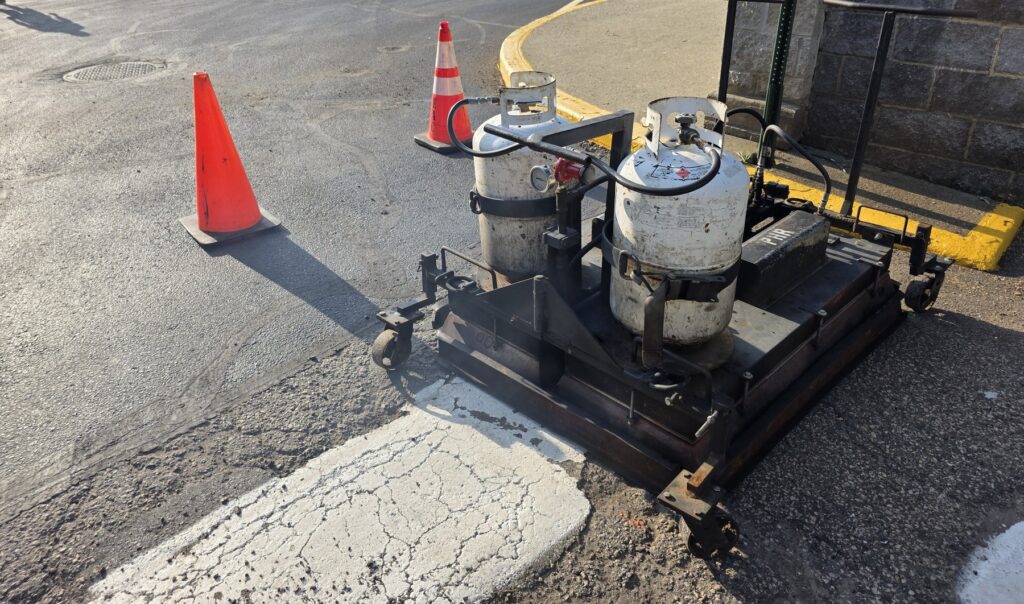
The photo at the top of this page is one of our thermal heaters staged on a coned drive aisle at a shopping center. That unit is the whole reason the cutoff does not apply to us. Instead of bringing hot material to a cold hole and racing the thermometer, the crew brings the temperature to the pavement. The existing asphalt in and around the pothole is heated until it is workable, raked and reworked with the surrounding surface, and then compacted while it is all still hot and all one material. The result bonds to the lot without the seam that a conventional patch leaves behind, which is the detail that matters most in winter, because the seam is where water would have gotten in.
That is thermal asphalt repair as we practice it on commercial lots, and the operational numbers are the same in February as in July: one truck, a two-person crew, about 20 minutes for most potholes, and the lot stays open while they work. Because the process reworks the asphalt that is already there, it also recycles the pavement on site instead of hauling it to a landfill. If you want to know how long a repair made in January holds up, we answered that in how long a thermal asphalt repair lasts on a commercial lot; the short version is that a winter thermal repair is the same permanent repair we make in May.
Two honest limits. First, a thermal crew still needs a dry working area: rain, snow or ice sitting in the hole stops the day until the area is cleared, because water in the material defeats compaction regardless of the method. Second, no surface repair of any kind holds over a base that has failed. If a section of the lot shows interconnected alligator cracking, soft spots that move under a delivery truck, or water that stands for a day after rain, the base underneath has gone, and the right answer is reconstruction by a paving contractor, not a patch from us or anyone else. We say so on the inspection report and mark those areas out of scope. We repair and save existing asphalt; we do not repave.
Should You Wait Until Spring to Fix a Pothole That Opens in November?
Direct answer: No. Damage should be addressed immediately. A pothole that opens in November is at its smallest and cheapest the week you find it. Freeze and thaw widens it every cycle, plows tear at the edge, and an open hole you knew about is the center of any claim. Thermal repair works all winter.
Winter is when potholes are made, not when they pause. Water gets into the hole and into the cracks around it, freezes, expands and pries the surrounding surface loose; the next thaw lets traffic break out the loosened pieces. A crumbling edge the size of a dinner plate in early November is routinely a tire-sized hole by February. The repair itself does not get harder with thermal equipment, but the area that needs repair gets larger, and so does the number of weeks the property carried a known hazard.
That last point is the one we would ask every facility manager to weigh. Snow removal contractors drive the lot in the dark. Tenants’ customers walk across it with their heads down in the wind. The accessible route from the parking space to the door has a quarter inch tolerance under the ADA standards, and a winter pothole on that route is not a maintenance item, it is a compliance item. We covered the winter case in more detail in can potholes be repaired in winter, and the answer there is the same as here: yes, and they should be, the week they open.
How Does the Cutoff Differ Between Mid-Atlantic and Florida Lots?
Direct answer: In the Mid-Atlantic the cutoff is cold and the plant calendar: from roughly November to March conventional hot-mix repair is outside the specification or out of material. In Florida there is no hard freeze and plants run year round, so the cutoff is water: wet surfaces and the afternoon rain stop a repair, and thermal repair fills the dry windows.
Our Mid-Atlantic territory, from Northern New Jersey and the Philadelphia metro down through Delaware, Baltimore, Washington, DC and Richmond, has the classic version of the problem. Nights drop below freezing from late fall, the plants go quiet, and the hot-mix season closes until spring. Thermal repair is the method that keeps those lots whole through that stretch, which is why our crews are busiest between December and March, not slowest.
Florida flips the equation. Orlando, Tampa and Fort Myers lots rarely see a freeze, and the plants do not shut down for cold, but the state still produces potholes on a schedule: heat softens the surface, afternoon storms saturate a sandy base, and delivery trucks do the rest, as we explained in why Florida parking lots get potholes without a single freeze. The cutoff there is the wet surface rule that every method shares. A thermal crew in Florida works the dry mornings and the dry season, and the advantage of a 20 minute repair is that it fits inside the windows the weather actually gives you.
What Should a Facility Manager Do Between the Plant Closing and Spring?
Direct answer: Walk the lot after the first hard freeze and after every plow event, log each pothole with a dated photo, prioritize entrances, fire lanes, drive-thru lanes, loading dock approaches and the accessible route, and have each one repaired the week it is logged. The repair record from each visit is what closes a claim file later.
The managers who come out of winter with a whole lot and an empty claims file run the season as a process, not a series of surprises. The first walk happens right after the first hard freeze, when the cracks that held water in October show what they have done. After that, every plow pass earns a walk the next morning, because blades expose and widen edges that looked fine the day before. Each defect gets a photo with a date on it, a location in the lot, and a rough size, which takes less time than it sounds and turns into evidence later.
Prioritizing is straightforward. The places people and vehicles cannot avoid go first: the entrance throat, the fire lane, the accessible route from the designated spaces to the door, the drive-thru lane and the loading dock approach. Perimeter spaces that stay empty until the holiday rush can wait a week; the entrance cannot. Then the hole is repaired, not plugged, and the repair gets its own photo, which closes the loop on the record. Properties on our PARC Plan get three scheduled inspections a year with a written report each time, so the winter walk is already on the calendar and the triage list is already built. For a single site, the same discipline fits on one page and a phone camera.
If a hole has opened on your lot this month, do not let the season decide when it gets fixed. Our crews repair potholes all winter across the Mid-Atlantic and Florida, and a commercial parking lot pothole repair takes about 20 minutes with the lot open. Start with a free inspection and you will have a dated list of what needs attention before the next freeze does its work.
Frequently Asked Questions
What is the minimum temperature for asphalt repair?
For conventional hot-mix asphalt, state specifications such as PennDOT Publication 408 stop placement when the air or surface temperature is 40 degrees Fahrenheit or lower, and at 50 degrees for thin or specialty mixes, always on a dry surface. Thermal asphalt repair has no comparable floor because it heats the existing pavement in place; it needs a dry, cleared work area rather than a warm day.
When do asphalt plants close for the winter in the Mid-Atlantic?
Plants close over the winter months, and the state paving seasons give the practical window: PennDOT’s runs April 1 to October 31 for most mixes, with thin wearing courses ending October 15. Some plants stay open into November if the weather holds. Once they stop, a conventional repair contractor has no hot mix until spring, which is why thermal repair is the winter method.
Should we wait until spring to repair potholes in our parking lot?
No. Damage should be addressed immediately. Every freeze and thaw cycle makes an open pothole larger, plow blades tear at its edge, and the property carries the liability for a known hazard the entire time. Thermal asphalt repair works all winter, so a pothole that opens in November can be repaired permanently that week with the lot open.
Does a thermal repair made in winter last as long as one made in summer?
Yes. The process is the same in either season: the existing asphalt is heated in place, reworked with the surrounding surface and compacted as one piece with no seam. Cold air does not change that bond because the heat is applied on site rather than carried from a plant. What shortens any repair’s life is a failed base or standing water, and both are checked at the inspection.
Does cold weather stop pothole repair in Florida?
Rarely. Florida lots almost never reach the hot-mix temperature floor and plants run year round, so the limiting factor is water rather than cold. A wet surface or an afternoon storm stops any repair until the area is dry. Thermal repair fits the dry windows well because most repairs take about 20 minutes, and the lot stays open throughout.
Is the season really over for your lot?
Not with us. Our crews repair potholes all winter across the Mid-Atlantic and Florida, with no plant calendar and no waiting for spring. Request a free pavement inspection and get a dated list of what needs repair before the next freeze decides for you.
Sources: Pennsylvania Department of Transportation, Publication 408/2020 Construction Specifications, Section 413.3(b) Weather and Seasonal Limitations (paving season April 1 to October 31; no placement when the air or surface temperature is 40F or lower; 50F for SMA and selected mixes). Colorado Asphalt Pavement Association, Best Practices for Cold Weather Paving (compaction temperature range approximately 275 to 175 degrees F; cooling time governed by mix temperature, lift thickness, air temperature, wind and sunlight).
