
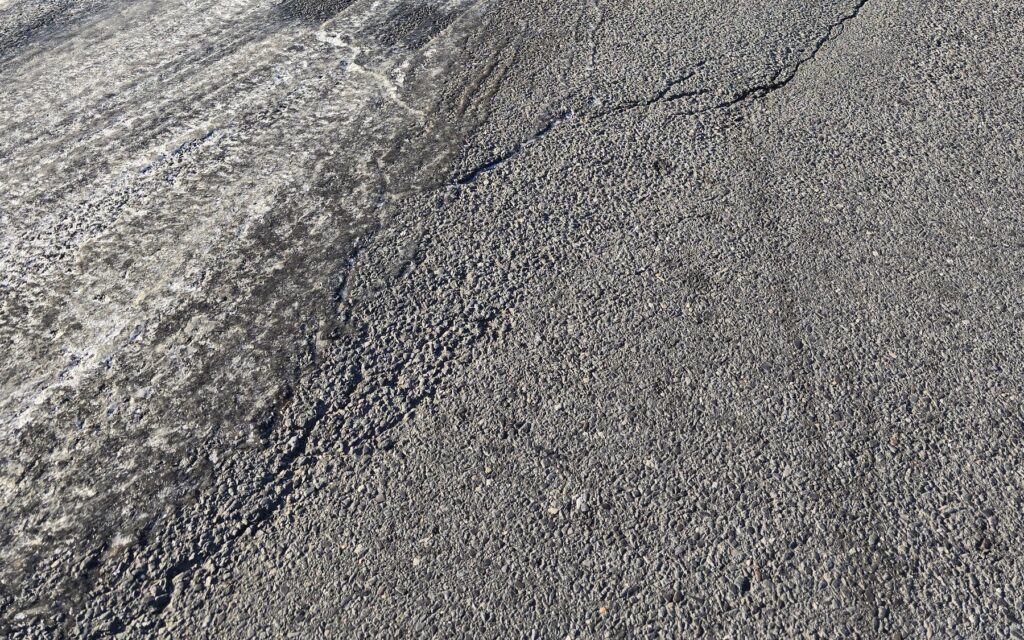
Every November a facilities manager somewhere in Maryland or New Jersey asks us the same thing while we walk a lot: is the salt doing this? They are pointing at a drive aisle that looks like the photo above, a white haze of dried brine down the traffic lane, a network of cracks beside it, and a patch from two winters ago that is opening up at its edge. The honest answer is that salt did not make the hole. Water made the hole. Salt made sure that water froze and thawed as many times as it possibly could, in every opening the lot already had.
This post is for the people who decide how a commercial parking lot gets treated and repaired through the winter: property and facility managers, HOA and condo boards, retail and portfolio operators across Maryland, Virginia, Washington DC, Delaware, Pennsylvania and New Jersey, with a note for our Florida clients at the end. It covers what de-icing does to asphalt, where the damage shows up first, whether you should change what you spread, and what the repair plan looks like now that the season is here. It comes from the side of the business that repairs potholes all winter, so it is not a reason to wait.
Key takeaways
- Road salt does not dissolve sound asphalt. It damages a lot indirectly, by keeping meltwater liquid in cracks and seams at freezing temperatures, which multiplies the freeze and thaw cycles the pavement goes through in one winter.
- A 2024 US Department of Transportation university study found that chloride deicers also penetrate the asphalt mix and binder, age the binder chemically and weaken the bond between binder and stone, and that diluted solutions did more damage than concentrated ones.
- Salt damage shows up first where the lot already has openings: cracks, the edges of old patches, utility cuts, the low spot by the catch basin where brine collects, and concrete curbs and ramps.
- Stopping salt is not the answer. An untreated lot is a slip and fall claim waiting for a plaintiff. The answer is closing the openings so the brine has nowhere to go.
- Salt damage should not wait for spring. Thermal asphalt repair works all winter, most repairs take about 20 minutes, and every week a pothole stays open through de-icing season it gets larger.
Does Road Salt Damage Asphalt?
Direct answer: Not directly, and yes in practice. Salt does not eat healthy asphalt the way it scales concrete. It lowers the freezing point of water, so meltwater sits liquid in cracks and seams and refreezes again and again through the season. Chloride solutions also work into the asphalt binder and weaken its grip on the stone, so existing damage grows faster.
Asphalt is stone held together by a petroleum binder. Sodium chloride does not react with that binder the way it reacts with the cement paste in a concrete sidewalk, which is why a lot can take years of salting and still look fine on the surface. What salt changes is the behavior of water, and water is what breaks asphalt. A pothole forms when water gets below the surface, freezes, expands, lifts the pavement, thaws, and lets traffic pound the loosened material out. On a salted lot the brine stays liquid at temperatures where plain water would have frozen solid and stayed frozen, so the pavement goes through that sequence on nights that would otherwise have been harmless.
The study that put numbers on this was published in August 2024 by South Dakota State University through the Mountain-Plains Consortium, a US Department of Transportation university transportation center. The researchers wrote that deicing chemicals “lower the freezing point and keep the precipitated water in the pavement in liquid form at freezing temperature,” which subjects the pavement to freeze and thaw cycles even in frigid weather and accelerates moisture damage and pothole formation. They also found something that surprised us: diluted salt solutions did more damage to the binder than concentrated ones, because the ions move more freely and get deeper into the mix. Diluted brine is exactly what sits in a parking lot crack in February.
What Does De-Icing Actually Do to a Parking Lot Over a Winter?
Direct answer: Three things. It keeps water liquid and moving inside every crack and seam, so the lot gets far more freeze and thaw cycles than the weather alone would deliver. It carries chloride into the binder, which ages it and loosens its bond to the stone. And it attacks concrete curbs, ramps and sidewalks directly.
Most of the Mid-Atlantic now treats pavement with liquid brine before a storm, not just rock salt after it. Maryland’s State Highway Administration describes its brine as 22 percent salt and 78 percent water, sprayed ahead of weather so snow never bonds to the surface, and the same agency reports cutting its overall salt use by up to half over five years by switching to that approach. We see brine pre-treatment on more commercial lots every winter. The result is that the lot is wet with salt water before the first flake lands, and that brine runs exactly where water always runs: into cracks, along the seams of old repairs, and down to the low spot in front of the catch basin.
Once it is in a crack, brine does what the study describes. The binder at the crack face ages and gets brittle. The bond between binder and stone weakens, so the edge of the crack ravels into loose aggregate. Traffic grinds that aggregate out and the crack becomes a depression. The depression holds more brine. By the thaw in March the lot has a pothole where it had a hairline crack in November, and the pothole is wider at the bottom than the top because the damage happened underneath.
Concrete is a different story, and it matters because the curbs, the accessible ramps and the entrance sidewalk are concrete. The Federal Highway Administration’s tech brief on chemical deicers says plainly that they amplify freeze and thaw deterioration in concrete by raising the saturation level and the pressures inside the material. That is why curb faces and ramp landings scale and pit after a salty winter while the asphalt beside them looks unchanged. We point it out on inspections because a scaled ADA ramp is a compliance problem, but it is concrete work, not ours, and we say so.
Where Does Salt Damage Show Up First on a Commercial Lot?
Direct answer: Wherever water could already get in. The edges of old patches, the seam along a utility cut, the drive aisle where plows push the slush, the low spot in front of a catch basin where brine pools and refreezes, and the crack network beside the main traffic lane. Sound asphalt with no openings comes through a salted winter unmarked.
After enough winters on the same portfolios you learn to walk a lot in a predictable order. The first stop is any repair that was done with a cold seam. A traditional patch is a plug of new asphalt sitting in a hole; the line where it meets the old surface never bonds, and that line is a channel. Brine runs down it, freezes, and lifts the patch edge. By the second winter the patch is loose and rocking under tires, and the owner is paying for the same hole a second time. That failure mode is the subject of our post on why asphalt patches fail at the seam, and salt season is when it happens fastest.
The second stop is the drive aisle past the front door, the lane in the photo at the top of this page. It carries the most traffic, it is where the plow operator stacks and drags the slush, and it gets the heaviest salt because it is the lane the property cannot afford to have icy. The white haze you see there is dried brine, and the cracks running beside it are where that brine went. The third stop is the catch basin. If the grate sits even half an inch high, or the pavement around it has settled, brine pools there for days. Standing brine refreezes every night, and the ring of broken asphalt around a drain is the most common pothole we repair in January across Baltimore, the Philadelphia suburbs and North Jersey.
The last stop is anything that was cut: a gas line trench, a fiber pull, an old light pole base. Utility cuts are backfilled by whoever did the work and sealed by nobody, so their perimeter is a seam on all four sides. Salt does not cause that distress. It finishes it.
Is Rock Salt, Brine, Calcium Chloride or Magnesium Chloride Easier on Asphalt?
Direct answer: No chloride product is kind to pavement, and the choice matters less than people hope. Rock salt, brine, calcium chloride and magnesium chloride all lower the freezing point and all carry chloride into the cracks. The 2024 study found diluted calcium chloride especially hard on the binder bond. Choose the product for ice control, then fix the pavement.
Our view after watching lots treated with all of them is that the product is a small lever. Every chloride deicer produces the same brine in the crack. The pavement result is governed by how many openings the lot has, not by which bag the operator opened.
| Treatment | What it does on the pavement | What to know as the property owner |
|---|---|---|
| Rock salt (sodium chloride) | Dissolves into brine in the first melt and follows the water into every crack and seam. | The most common product on commercial lots. Bounce and scatter puts a share of it in the landscape beds and the drains. |
| Salt brine (pre-treatment) | Arrives as liquid before the storm, so the lot is wet with salt water from the start and the brine reaches the low spots first. | Uses less total salt, which is why the state agencies moved to it. It makes a sealed, well drained lot more important, not less. |
| Calcium chloride | Works at lower temperatures and draws moisture from the air. In the 2024 study its diluted solutions were the most damaging to the binder and stone bond. | Usually chosen for the coldest nights or for ramps and entrances. Expect it to find the same seams faster. |
| Magnesium chloride | Another chloride; the same freezing point effect and the same chloride load in the cracks. | Often sold as gentler. Gentler on plants and metal is not the same as gentler on a seam. |
| Acetate blends and sand | Acetates carry no chloride. Sand adds traction and melts nothing; it ends up in the catch basins. | Useful in specific spots. Neither changes the physics of water in an open crack. |
Should We Stop Salting to Protect the Asphalt?
Direct answer: No. An icy commercial lot is a slip and fall claim with your property’s name on it, and a pedestrian injury costs more than any pothole. Keep treating the lot to the standard your snow contract and your insurer expect. Protect the asphalt by closing its openings before and during the season, not by leaving ice on it.
We have never once advised an owner to salt less to save pavement, and we repair pavement for a living. The duty to keep walking and driving surfaces reasonably safe does not pause because de-icing is hard on asphalt, and the people who would argue otherwise are not the ones who get named in the complaint. Our post on the liability hiding in small asphalt repair decisions walks through how that exposure accumulates. Salt stays. What changes is the pavement the salt lands on.
There is a quieter reason to get the pavement right, too. Maryland’s Department of the Environment has said that once salt enters the environment “there is no effective way to remove it,” and state salt management plans now push every agency and contractor toward using less. A lot that drains properly and has no broken areas holding slush needs less product to stay safe.
Should Salt Damage Wait Until Spring to Be Repaired?
Direct answer: No. Damage should be addressed immediately. A pothole opened by de-icing in December takes brine and freezes every night until March, and each cycle removes more material. Thermal asphalt repair does not depend on the paving season or a plant calendar, so there is no technical reason to let a hole grow for four months.
The spring repair habit comes from the paving industry, where hot mix is unavailable once the plants close and the season has a published cutoff. We wrote about that cutoff and what still works below it in how cold is too cold to repair a parking lot. The short version is that thermal asphalt repair heats the existing pavement in place, reworks it with fresh material, and compacts the area as one continuous surface, so it needs a dry work area rather than a warm month. Our crews do it from November through March across the Mid-Atlantic, and the details of why it holds are in our post on repairing asphalt in winter.
Waiting also costs more than the repair. A hole that could have been closed in about 20 minutes in December is a wider, deeper repair in April, often with a damaged base under it, and in between it has been photographed by every customer with a phone, the subject of our post on the first 48 hours after a pothole damage claim. For a lot in Washington DC, Richmond or Wilmington, the winter repair is the smaller one.
What Does the Repair Plan Look Like Before and During De-Icing Season?
Direct answer: Inspect the lot before the first brine goes down, close every pothole, failed patch edge and broken utility seam with a bonded repair, clear the catch basins so brine drains instead of pooling, then re-inspect after the first thaw. Repair anything new the week it appears rather than collecting a spring list.
The plan we run for portfolio clients is not complicated. In late fall a specialist walks every lot and marks what is open: potholes, patches that have lifted at the edge, utility cuts that have settled, raveled areas around drains. Each one gets photographed and documented in the inspection report so the board or the asset manager can approve exactly what is being repaired and why. That report is also the record that answers an insurer or an attorney later, which is why clients on the PARC Plan get it three times a year with the repairs scheduled around their region’s stress seasons. The post on what belongs in a commercial asphalt repair scope shows what that document should contain.
The repairs themselves are done section by section with cones, so the lot stays open. Then the season runs, and the lot gets walked again after the first real thaw, because that is when the new damage reveals itself. Whatever is found is repaired that week. The difference between a lot that comes out of winter in good shape and one that needs a spring campaign is almost never the snow contractor’s product. It is whether the openings were closed in November and whether the January damage was repaired in January.
Two things we will tell you honestly during that walk. If the concrete curbs and ramps are scaling, that is salt attacking the concrete and it needs a concrete contractor. And if brine is pooling because the pavement around a drain has settled or the drain itself is clogged, a patch alone will not solve it; the drainage has to be corrected or the ring of broken asphalt will return. We repair and save existing asphalt, which means telling you when the problem is not asphalt.
What This Means for Mid-Atlantic and Florida Lots
For a commercial property in Maryland, Virginia, DC, Delaware, Pennsylvania or New Jersey, de-icing season is the hardest period of the year on the pavement, and the damage is almost entirely a function of how many openings the lot had going in. Salt is going down regardless. What a property manager controls is whether the brine finds a bonded surface or a network of seams, and whether the holes that open in December are closed in December. Across retail centers, HOA and condo communities and the industrial parks of central Pennsylvania, the lots that hold up are the ones repaired through the winter, not after it.
For our Florida clients the de-icing question does not arise, but the chloride one does. Coastal lots from Jacksonville to Miami live in salt air year round, and binder aging shows up as raveling along the edges and around drains, driven by rain and heat instead of freezing. We covered that in why Florida parking lots get potholes without a single freeze. The repair answer is the same across our territory: close the openings, keep the water moving, and do it now. Commercial parking lot pothole repair is the whole of what we do, and the inspection that starts it is free.
Frequently Asked Questions
Can you put salt on an asphalt parking lot?
Yes. Rock salt and brine are used on asphalt lots across the Mid-Atlantic every winter, and keeping the lot safe for pedestrians and vehicles comes first. Salt does not dissolve sound asphalt. It damages a lot indirectly by keeping meltwater liquid in cracks and seams through repeated freezing, so the way to protect the pavement is to repair every opening before and during the season, not to stop treating ice.
What are the downsides of using road salt on a commercial lot?
On the pavement, more freeze and thaw cycles in every crack, chloride working into the asphalt binder and loosening its bond to the stone, faster failure at patch edges and utility seams, and direct scaling of concrete curbs and ramps. Off the pavement, corrosion of vehicles and metal, damage to landscaping, and chloride in stormwater that state environmental agencies say cannot be removed once it is in the watershed.
Does salt damage a new asphalt repair?
A bonded thermal repair has no cold seam for brine to enter, so it goes through de-icing season the same way the surrounding sound pavement does. A traditional patch with an unbonded edge is a different matter: the seam is a channel, brine runs down it and freezes, and the patch edge lifts within a winter or two. If a repair is going to see salt, how it was bonded matters more than how new it is.
Is brine worse for asphalt than rock salt?
Not in the way people expect. Brine uses less total salt than dry rock salt, which is why Maryland and other states moved to pre-treating with it. What brine changes is timing: the lot is wet with salt water before the storm, and the liquid runs to the low spots and seams immediately. On a lot with no openings that makes little difference. On a lot with failed patch edges and a pooling drain it finds them faster.
Should we wait until spring to repair potholes caused by salt and ice?
No. Damage should be addressed immediately. Every freeze and thaw cycle between December and March removes more material from an open pothole, and the hole that is repaired in spring is wider and deeper than the one that opened in winter. Thermal asphalt repair heats the existing pavement in place and works all winter, most repairs take about 20 minutes, and the lot stays open while the work is done.
Is your lot ready for the first brine of the season?
Find out before the snow contractor does. Our specialists walk the lot, mark every pothole, failed patch edge and broken seam, and send you a documented inspection report with the repairs scheduled around your operations. We repair all winter across the Mid-Atlantic and Florida, and the inspection is free.
Sources: Ghabchi, R. and Mihandoust, M., Effect of Deicing Agents and Environmental Conditions on the Performance of Asphalt Pavements in Cold Regions, Mountain-Plains Consortium report MPC 24-549, South Dakota State University, August 2024 (US Department of Transportation University Transportation Centers Program): deicers keep water liquid at freezing temperatures and subject pavement to additional freeze and thaw cycles; chloride solutions penetrate the mix and binder, induce chemical aging and debond binder from aggregate; diluted calcium chloride solutions produced the lowest tensile strength ratios. Federal Highway Administration, Tech Brief FHWA-HIF-17-008, Chemical Deicers and Concrete Pavement: Impacts and Mitigation, March 2018: chemical deicer applications amplify the physical mechanisms of freeze and thaw deterioration in concrete, including increased saturation and osmotic pressure. AASHTO Center for Environmental Excellence, Maryland Works to Reduce Road Salt’s Environmental Impact: MDOT SHA brine is 22 percent salt and 78 percent water, salt use reduced by up to 50 percent over five years; Maryland Department of the Environment: once salt enters the environment there is no effective way to remove it. Maryland State Highway Administration, Statewide Salt Management Plan.
