
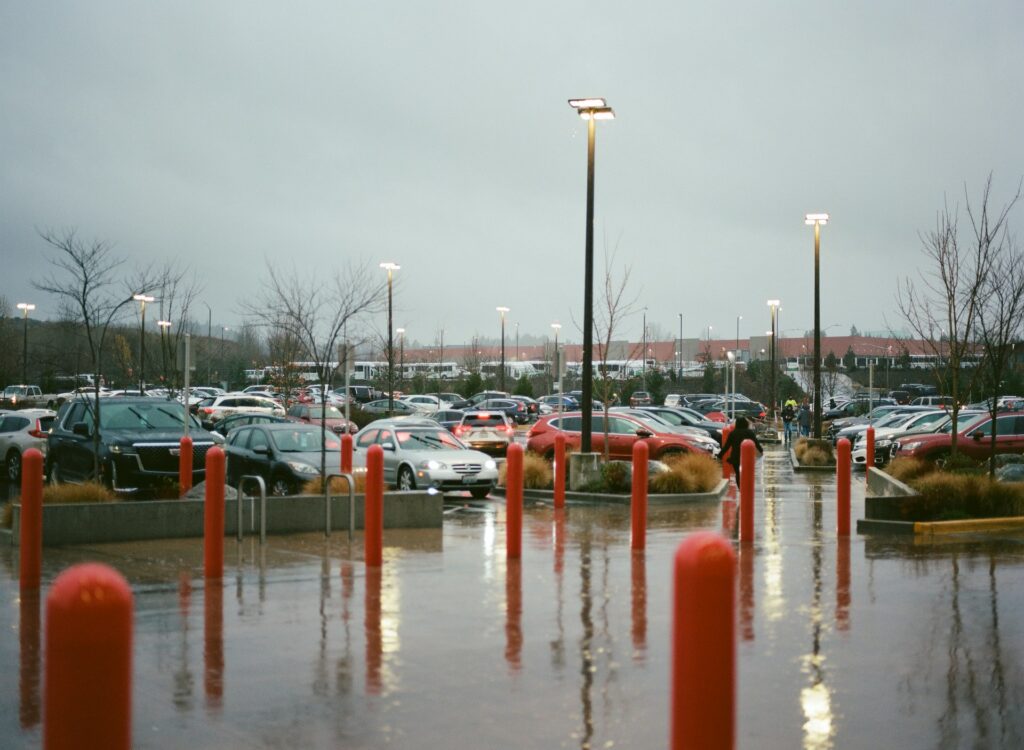
A storm does not need a name to wreck a parking lot. Heavy rain, wind, and fast temperature swings all go after the same weak points in commercial asphalt, and they go after them every single time. If you manage a property, you feel it within days: tenant calls, trip and tire claims, and pressure to keep entrances and drive lanes open while you figure out what actually broke.
This playbook is for the people who own that problem: property and facility managers, HOA and condo boards, and multi-site operations teams across the Mid-Atlantic and Florida. It covers how storms actually damage asphalt, what to check in the first 48 hours, and how to turn every storm from a scramble into a routine your team runs on autopilot.
Key takeaways
- Storm damage to asphalt is water damage: rain enters existing cracks, saturates the base underneath, traffic pumps the softened material out, and potholes open up days after the sky clears.
- The first 48 hours are about liability, not repairs: cone and photograph every hazard at entrances, drive lanes, and loading zones before anything else.
- Repairs that survive the next storm remove the failed material down to firm base and bond new asphalt to old with no cold seam; quick cold-patch fills wash out with the next heavy rain.
- Scattered potholes and edge failures are repair scope, not repave scope. Section-by-section repair keeps the lot open and pushes the repaving conversation years down the road.
- A standing post-storm plan, covering who inspects, what gets logged, and who gets called, is the difference between a calm Tuesday and a week of emergency calls.
How do major storms damage commercial parking lots?
Direct answer
Storms rarely break healthy pavement outright. Rain drives water through existing cracks, old patches, and utility cuts into the base layer. Traffic then pumps that saturated base out from under the surface, and the unsupported asphalt collapses into potholes, often days after the storm has passed.
Water is the whole story. Heavy rain and standing water push into hairline cracks, aging patch seams, and the edges where asphalt meets concrete or soil. Once moisture reaches the base, every vehicle that crosses the spot works like a pump, flexing the surface and squeezing softened material out to the sides.
That is why the worst damage shows up late. A lot can look fine the morning after a storm and grow three new potholes by the following week. Along with potholes you will see raveling, where the surface sheds loose stone and turns rough, and shallow depressions that pond water and set up the next round of damage.
The climate does not give you an off season either. Mid-Atlantic properties take nor’easters, tropical remnants, and freeze cycles on pavement that is already wet. Florida lots trade the freeze for near-daily summer downpours and hurricane season. Different weather, same mechanism, same result. When you spot these signs, bring in a professional repair team to evaluate the damage; our pothole and small asphalt repair services page covers how that evaluation works.
What should property managers check in the first 48 hours after a storm?
Direct answer
Walk the highest-traffic areas first: entrances, main drive aisles, loading zones, and ADA routes. Cone or barricade anything that could catch a tire or trip a pedestrian, photograph every hazard, and log its location and size. Those controls are not repairs; they cut your liability while the real fix gets scheduled.
The first two days are about safety and liability control, full stop. Walk or slowly drive the lot in a standard route and hit the places where a failure costs you most:
- Entrances and exits, where traffic never stops
- Main drive aisles, crosswalks, and ADA accessible routes
- Loading and delivery zones, where the heaviest axles concentrate
- High-turn areas near drive-thru lanes and building entries
In each area, look for potholes deep enough to catch a tire, ponding water that hides damage underneath, crumbled edges along curbs and sidewalks, and soft or spongy spots in the tire paths. Ponding deserves special suspicion: water standing where it never stood before means the surface has moved.
Cone it, tape it, sign it, and photograph all of it. Notes on location, size, and how traffic uses the spot turn a repair visit from an estimate walk into a work order. If you need a framework for deciding what gets fixed this week versus this quarter, our 24 to 72 hour triage framework for emergency versus planned repairs was built for exactly this moment.
What belongs in a post-storm parking lot maintenance plan?
Direct answer
Name who inspects each site and how soon after a storm, give them a standard route and one shared log, and sort findings into three buckets: emergency repairs for hazards, near-term repairs that close water entry points before the next storm, and a watch list you re-check monthly.
If every storm triggers a new scramble, the missing piece is not effort, it is a plan. A workable one fits on a page:
- Who inspects each site, and within how many hours of a storm
- The standard inspection route, so nothing gets skipped
- One shared log with photos, so findings do not live in five text threads
- Who gets called for each bucket of damage, agreed before storm season starts
The buckets matter. Emergency repairs cover anything that threatens safety or access. Near-term repairs close the openings that let water in, so the next storm has fewer entry points to exploit. Everything else goes on a watch list with a re-check date, because a stable crack in September is not always a stable crack in November.
One honest boundary belongs in the plan too: if an inspection shows base failure across most of a lot rather than scattered potholes and edges, that is a capital repaving conversation, not a repair ticket. The job of a disciplined repair program is to make that conversation happen years later than it otherwise would. Our guide to evaluating repair services before you repave walks through that decision with real criteria.
Which repairs actually hold up after repeated storms?
Direct answer
The ones that remove failed material down to firm base and bond new asphalt to the old surface with no cold seam. Thermal asphalt recycling heats the pavement around the hole and blends new material into it seamlessly. A cold patch tossed into a wet hole is usually gone by the second storm.
Right after a storm it is tempting to have someone fill the holes and move on. That instinct is how the same pothole ends up on three consecutive work orders. A quick fill does nothing about the water path that created the hole, and the cold seam around a conventional patch is the first place the next storm gets back in.
Repairs that last share two traits. First, the failed material comes out, down to base that can actually carry load. Second, the new asphalt is bonded to the old, hot, with no seam for water to exploit. That is the core of the thermal asphalt recycling method our crews run: heat the pavement around the failure, rework and blend it with fresh material, and compact it as one continuous surface.
For a busy commercial lot, the operational side matters as much as the engineering. Each repair is coned individually, completed, and reopened the same day, so entrances and drive lanes stay in service the whole time. That section-by-section approach is how busy sites get potholes fixed with zero disruption, whether the property is a retail plaza in Charlottesville or a hotel lot on the Florida coast.
How should multi-site portfolios prepare for storm season?
Direct answer
Rank sites by traffic and business impact before the season starts, flag the ones with known drainage problems or older pavement, and pre-agree scope and response standards with one repair partner. When a storm hits twenty properties at once, dispatch should be a list you already have, not a negotiation.
One storm system can hit dozens of properties in an afternoon, each with different pavement ages, layouts, and traffic. The portfolios that come through clean are the ones that did the ranking before the radar lit up: which sites carry the most traffic, which ones already pond water, which entrances and loading docks cannot close under any circumstances.
The other half is standardization. One repair partner across markets means one quality standard, one reporting format, and one set of site photos, instead of a different method and a different excuse at every location. Our multi-site pothole repair SOP covers scope, QA, and reporting for exactly this setup, and the commercial solutions page shows how the program scales from one lot to a national portfolio.
Turn storm damage into a stronger pavement strategy
Every storm maps your weak points for you. The lot that ponds at the same corner, the entrance that grows a pothole every season, the patch that never holds: that is free engineering data. Fold it into the annual repair budget and the drainage fixes you prioritize, and each storm season starts with fewer open doors for water than the last one.
Get a free post-storm inspection
The fastest way to know what a storm actually did to your lot is to have someone qualified walk it and document every failure point before you commit budget. Pothole Repair crews serve commercial properties across the Mid-Atlantic and Florida with repairs that keep the lot open while the work happens. Request your free inspection at potholerepair.com or call 855-376-8465.
Frequently asked questions
How soon after a storm should a commercial parking lot be inspected?
Within 48 hours. Hazards need cones and photos immediately for liability control, and early findings feed the repair schedule. Then re-walk the lot one to two weeks later, because base saturation means some potholes only appear after traffic has worked the softened spots.
Why do potholes show up days after the storm instead of during it?
The storm loads the base with water; traffic does the demolition afterward. Each passing vehicle flexes the saturated pavement and pumps softened base material out from underneath, and the surface collapses once enough support is gone. That process takes days to weeks, which is why post-storm inspections need a follow-up pass.
Can storm damage be repaired without closing the parking lot?
Yes. Repairs are done section by section: only the area being worked is coned off, and it reopens to traffic the same day. Entrances, drive lanes, and surrounding stalls stay in service, and scheduling follows the property’s slow hours.
When is storm damage a repaving problem instead of a repair problem?
Scattered potholes, failed patches, and crumbling edges are repair scope, fixable section by section with the lot open. Base failure across most of a lot is a capital repaving project, and no honest repair contractor will patch their way around it. A disciplined repair program exists to push that day years further out.
