
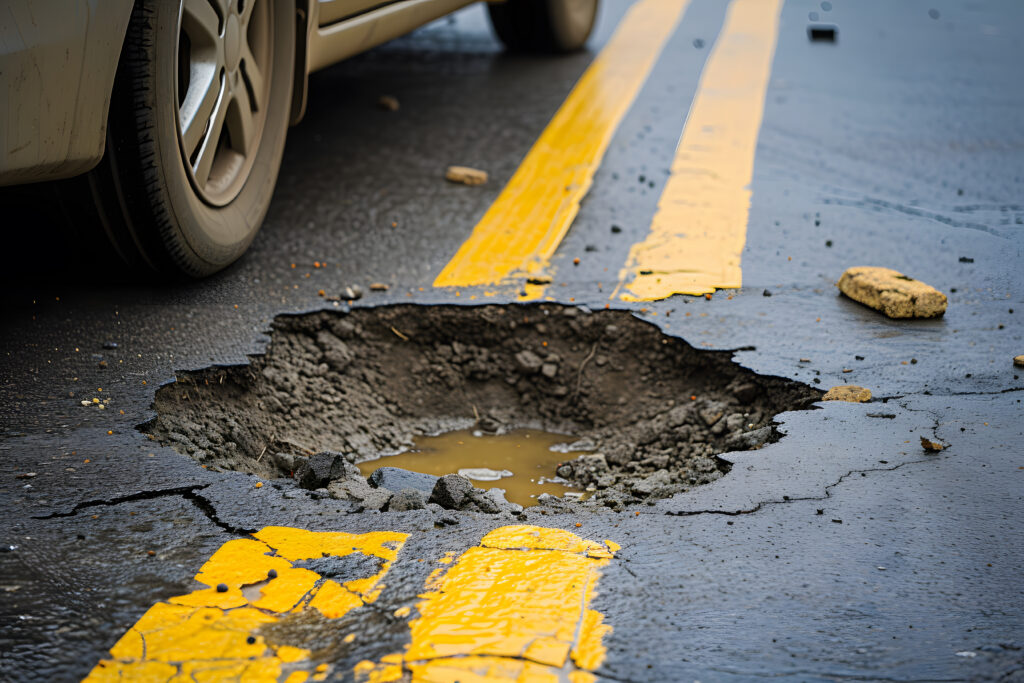
“Parking lot repair” and “pothole repair” get used as if they mean the same thing, and that confusion costs property managers money. Call a paving contractor about three potholes and you may walk away with a proposal to resurface the whole lot. Call for a quick patch on a section whose base has failed and you will pay for the same patch again next year. The two are different kinds of work, solve different problems and disrupt a property in very different ways.
This guide explains what each one covers, how to tell which one your lot needs, how the costs compare in practical terms, and why the decision matters for liability as much as for the budget.
Key takeaways
- Pothole repair fixes specific failures in otherwise sound pavement and keeps the lot open while the work is done.
- Broader parking lot work, such as resurfacing or rebuilding a section, replaces pavement and usually closes that area for days.
- Most lots that look bad are sound lots with a handful of open potholes and failed patches. Those are repairable.
- Resurfacing over unrepaired base failures does not fix them. The failures come back through the new surface.
- A written inspection that separates repairable damage from true base failure is the starting point for either decision.
What Counts as Pothole Repair?
Direct answer: Pothole repair restores individual failures in a parking lot, such as open holes, broken edges, failed old patches and settled spots, so the surface is safe and sealed again. It works on the asphalt you already have, one area at a time, without closing the lot.
A permanent pothole repair removes the weak, loose material, rebuilds the area and bonds the new surface to the surrounding asphalt so there is no seam for water to get into. Our thermal method heats the existing asphalt and recycles it into the repair, and a typical repair is ready for traffic in about 20 minutes. That is the difference between a repair and a patch: a patch sits in the hole, a repair becomes part of the pavement.
Pothole repair is the right tool when the problems are local: a few holes in a drive lane, damage at an entrance, a dumpster pad that keeps breaking up, old patches that have lifted out.
What Counts as Parking Lot Repair?
Direct answer: “Parking lot repair” is a broad term. Besides pothole repair, it is used for work that replaces pavement or changes the lot itself, such as resurfacing, rebuilding failed sections down to the base, correcting drainage and grading, and restriping. That work is done by paving and site contractors.
Those projects have their place. A lot where the base has failed across large areas, or where water has nowhere to go, needs more than surface repair. The catch is that larger projects take whole sections out of service, often for days, and they are frequently proposed for lots that only needed a handful of repairs. We repair and save existing asphalt. When a section is beyond repair, we document it so you can bring in the right contractor for it, but we do not resurface or repave.
How Do You Tell Which One Your Lot Needs?
Direct answer: Look at how much of the lot is affected and whether the base is moving. Isolated holes and failed patches in otherwise firm pavement point to pothole repair. Wide areas of interconnected cracking that flex underfoot, or broad depressions that hold water after every rain, point to base failure in that section.
| What you see | What it usually means | Right next step |
|---|---|---|
| A few open potholes in drive lanes or at entrances | Local failures in sound pavement | Permanent pothole repair |
| Old patches that keep lifting out | Temporary fill with no bond to the surface | Replace with a bonded repair |
| Breakup at a dumpster pad or truck route | Heavy loads concentrated on one area | Repair, then keep it on the inspection route |
| Large areas of cracking that move underfoot | Base failure across the section | Outside pothole repair scope. Document it and budget reconstruction |
| Wide low areas that flood after every storm | Grading or drainage problem | Repair the potholes, bring in a drainage contractor for the rest |
If you are not sure, that is what an inspection is for. Ours maps every failure on the lot, separates what can be repaired from what cannot, and puts it in writing. You can see what finished work looks like in our before and after gallery.
How Do the Costs Compare?
Direct answer: Pothole repair is scoped to the damage that exists, so you pay for the failures on your lot rather than for a whole new surface. Resurfacing or reconstruction is priced across an entire area and adds the cost of closing it. The bigger hidden cost is repeating work: patching the same holes every year, or resurfacing over failures that come back.
The cost conversation is less about the price of one repair and more about how often you pay for the same problem. A pothole patched with cold fill three times in two years has cost more than one permanent repair. A lot resurfaced over unrepaired base failures carries those failures into the new surface. And any project that closes part of a lot has a cost that never shows up on the invoice: lost parking, tenant complaints and rerouted deliveries. Every quote we provide is written for your specific lot after an inspection.
Why Does This Decision Matter for Liability?
Direct answer: Because an open pothole is a hazard every day it waits for a bigger project to be approved. Repairing hazards promptly, and keeping a dated record of when they were found and fixed, protects people on the property and protects the owner if a claim comes in.
Large projects take months to plan, approve and schedule. If a lot’s potholes are left open while a resurfacing budget works its way through approvals, every one of those holes stays a trip and vehicle damage risk the whole time. Fixing hazards now and planning larger work separately is both safer and easier to defend. This is general guidance, not legal advice. For more, read the liability risks hiding in small asphalt repairs.
What Is the Smartest Approach for Most Commercial Lots?
Direct answer: Repair what can be repaired now, put the lot on a regular inspection schedule so new damage is caught while it is small, and plan larger work only for sections the inspection shows are beyond repair.
- Repair the hazards. Permanent repairs on every pothole in drive lanes, entrances and walking paths.
- Inspect on a schedule. A fixed route and a dated log, with checks after major storms. The PARC Plan does this for you and extends the warranty on covered repairs.
- Plan the big work separately. If a section has truly failed, document it and budget it as its own project instead of letting it hold up the repairs the rest of the lot needs.
Frequently Asked Questions
Is pothole repair the same as parking lot repair?
No. Pothole repair restores specific failures in existing pavement and keeps the lot open. Parking lot repair is a broader term that also covers resurfacing, rebuilding failed sections, drainage work and restriping, which replace or change the pavement and usually close the affected area.
Can pothole repair delay the need to resurface a lot?
Often, yes. Most of the damage that makes a lot look worn out is local: open potholes and failed patches in otherwise sound pavement. Repairing those permanently and catching new damage early keeps a sound lot in service. Sections where the base has failed are the exception and need their own plan.
Do you have to close the parking lot for pothole repair?
No. Repairs are done one area at a time while the rest of the lot stays open, and a typical repair is ready for traffic in about 20 minutes.
What if part of my lot is beyond repair?
Our inspection will say so. We repair what can be saved and document the sections where the base has failed so you can plan that work with the right contractor. Fixing the repairable damage first keeps the property safe while the larger project is planned.
Who is responsible for potholes in a commercial parking lot?
Generally the property owner, or the manager acting for the owner, is expected to keep the lot reasonably safe, and the lease usually sets out who pays for repairs. A dated inspection and repair record is the document that matters if a claim comes in. This is general guidance, not legal advice.
Not Sure Which One You Need?
Start with an inspection. Request a free inspection and we will map every failure on your lot, tell you what can be repaired and what cannot, and send a written quote. We serve commercial properties across the Mid-Atlantic and Florida, including Philadelphia, Baltimore and Orlando.
